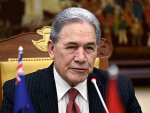
Winston Peters' FTA attacks 'just dog whistling' - Jacobi
International trade expert Stephen Jacobi says Winston Peters' objections to the Indian free trade deal are "ridiculous".




 increase font size
 Stephen Jacobi
Few trade agreements have generated as many column inches – or as much protest - as the Trans-Pacific Partnership (TPP).
The recent meeting of TPP ministers in Maui represents an important turning point in the quest for this complex agreement. Ministers succeeded in significantly narrowing the remaining issues, of which market access, intellectual property and investment are among the most important for New Zealand.
Our economy is built on trade, yet we face ludicrously high tariffs on agricultural products in markets including Japan, Canada and the US.
What’s more, as economies become increasingly integrated and inter-connected, trade and investment are changing. The focus is shifting from goods, to services and investment, and the speed and cost of doing business. The time has come to put tariffs to bed and concentrate on issues like investment, supply chain connectivity, regulatory alignment and innovation.
Back in 2011 TPP leaders committed to concluding a “high quality, ambitious and comprehensive” agreement. From NZ’s perspective this means an agreement that, over time, will result in tariff elimination for all products, all participants sharing equally in the benefits.
Timetables and safeguard arrangements may vary, but there should be no exceptions.
For NZ the crunch point relates to dairy products, which represent some 25% of our exports. The question is whether NZ is able to gain access to a meaningful share of dairy consumption in Japan, Canada, the US and Mexico and under what conditions.
Dairy is to NZ what motor vehicles are for Japan, wheat and grain for Canada, textiles for Viet Nam, but with one major difference -- global dairy markets are even more plagued by high trade barriers. NZ cannot be expected to accept an outcome on dairy that is significantly inferior to what others receive for their products of major export interest.
But dairy isn’t the only issue. Tariffs paid to TPP economies in just four sectors – beef, horticulture, seafood and wine – amount to at least $130 million a year. Remember also that other participants have significant unresolved market access issues – Australia on sugar, Viet Nam on textiles -- while products like rice and motor vehicles continue to be problematic.
Much concern has been raised about intellectual property, with wild rumours circulating about software patents and illegal downloads. Much of this has proven to be misinformation. The advice of NZ negotiators is that TPP largely upholds the status quo in NZ, except in the area of copyright where the current term of life plus 50 years may be extended.
On the question of medicines, the Prime Minister has said that the role of Pharmac will be protected and that where increased patent terms or longer protection of data for new generation biologic medicines results in increased costs, there will be additional funding and NZers will not pay more for prescriptions.
With regard to investment, the Government advises there will be protections for the continuing right to regulate regarding public health and the environment, and the Treaty of Waitangi will be fully protected. Provided the text is well drafted, the risk to NZ from future investor state dispute settlement should be minimal.
Nor will TPP be thrust upon us in secret. In NZ, established constitutional practice for all treaties – including TPP -- is that the text is concluded and signed by the Government. Before the treaty can be ratified, the text will be published and scrutinised by Parliament. Anyone with concerns will have the opportunity to make submissions to the select committee.
TPP may not be the long hoped-for ‘big bang’ for trade and investment liberalisation, but nor will it be the Armageddon for domestic sovereignty and policy making that some would have us believe.
TPP represents an extraordinary attempt on the part of twelve governments to deliver a more seamless environment for business. It is more than the sum of its parts: beyond dairy products, beyond motor vehicles, beyond intellectual property; at stake is the future of economic integration in the region.
That makes the potential prize of TPP worth the effort.
• Stephen Jacobi is executive director of the NZ International Business Forum.
International trade expert Stephen Jacobi says Winston Peters' objections to the Indian free trade deal are "ridiculous".

Leading trade analyst Stephen Jacobi has rubbished claims that New Zealand could have got a better free trade deal with India if it had prolonged the negotiations.
OPINION: Over the past month, people up and down the country have been asking me what I think is in store for the Agri sector.
OPINION: Despite the volatility created by the shoot-from-the-hip trade tariff 'stratefy' being deployed by the new state tenants in the White House, farm commodity prices are holding their own.
New Zealand’s top business leaders are urging the US Administration to review “unjustified and discriminatory tariffs” imposed on Kiwi exporters.



DairyNZ deputy chair Cameron Henderson has been re-appointed unopposed for another term.
Farms across the upper North Island are trialling different pasture mixes as part of a research programme that aims to build greater resilience into farming systems.
Election years are always a concerning time for farmers, according to DairyNZ chair Tracy Brown.
The Ballance Farm Environment Awards are coming to the West Coast of the South Island.
Most dairy regions around the country have had a pretty good season so far says Tracy Brown.


OPINION: The same mainstream media muppets that brought you Jacindamania in 2017 have been flat out pimping for the Opportunities…
OPINION: Your old mate reckons the atrocious way farmers in the UK are treated by their lords and masters in…