
Tracking system saves transport operator time and money
Southland based Herbert’s Transport is a rural transport company that operates a mixed fleet of around 50 vehicles – including livestock, bulk trucks, spreaders, whey trucks and trailers.




 increase font size
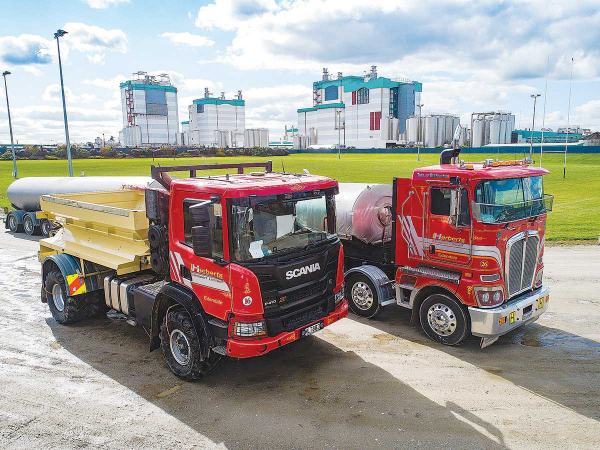 All trucks have Teletrac Navman's GPS-based fleet tracking system.
Herberts Transport is a rural transport company, established in 1918, that operates a mixed fleet of around 50 vehicles, including livestock, bulk trucks, spreaders, whey trucks and trailers.
Alongside carting products for Fonterra, they also carry gravel, cement, and coal, operate vacuum trucks and a fleet of modern tractors, slurry spreaders and muck spreaders.
As a business that supports the dairy and the overall agriculture industry, like many farmers they have a similar focus on increased efficiency, in order to keep up with demand and support overall productivity. This led the company to look for an easy-to-use tracking system to provide an overview of the status and location of all their fleet, along with features like service alerts and electronic Road User Charge reconciliation to help eliminate time consuming manual processes, and better serve their rural customers.
Extensive research led to the installation of Teletrac Navman’s GPS-based fleet tracking system, which alongside streamlining operations, has also delivered large cost and time savings.
Having a full overview of where all the vehicles in his fleet are, and what they’re doing, translates into better communication with farming customers, less admin time and a well-maintained fleet for managing director Scott Hutton. “Through the app on my phone, I can quickly check the status of all divisions of vehicles through the easy-to-use overview,” says Hutton.
“So, if a farmer asks about our ETA, I can easily check the truck location on the app and let them know”, he says. This saves time for both the farmers, who can better manage exactly when they need to meet contractors at the gate with other tasks, and Herberts Transport.
Servicing rural areas also means operators need to be on top of Road User Charges (RUC) to ensure you don’t get caught without a licence or lose out on rebates – the latter having a significant impact on a company’s bottom line.
Herbert Transport is using electronic RUC monitoring for both diesel fleet vehicles and independent trailers, as it automates RUC licencing and rebates, and calculates each distance travelled on private roads to provide correct rebates. Previously, managing the RUC on independent trailers was impractical and time-consuming, only needing one broken wire or a driver with multiple trailers to manually enter the wrong RUC details, and it would affect the RUC data, causing headaches down the line.
Combined with the auto purchasing technology, the system saves Scott Hutton’s team at least a couple of hours a week in administration time.
“When submitting the rebates for private roads, all the info is there. We just click on a button to submit and that means more time saved,” says Hutton.
Southland based Herbert’s Transport is a rural transport company that operates a mixed fleet of around 50 vehicles – including livestock, bulk trucks, spreaders, whey trucks and trailers.


National’s pledge to introduce 19 new national standards shows the party is serious about getting Wellington out of farming, Federated Farmers says.
The National Party’s policies to make it easier to grow fresh vegetables, secure reliable water and energy and simplify farm planning are practical changes that will give growers the confidence to invest, according to Horticulture New Zealand (HortNZ).
Fonterra Co-operative Group chief financial officer Andrew Murray has resigned to take up a role outside the dairy giant.
A major move is about to get underway to improve the quality and viability of dairy beef and cattle in NZ.
Veterinarians say changes to the code of welfare for dairy cattle provides a positive foundation for improved cattle welfare across the country.
Today, 15 October, is the International Day of Rural Women, which recognises rural women’s contribution to farming, communities and the environment.


OPINION: It seems Canterbury processor Synlait is still in the doldrums.
OPINION: Get offside with New Zealand First leader Winston Peters at your own peril.




