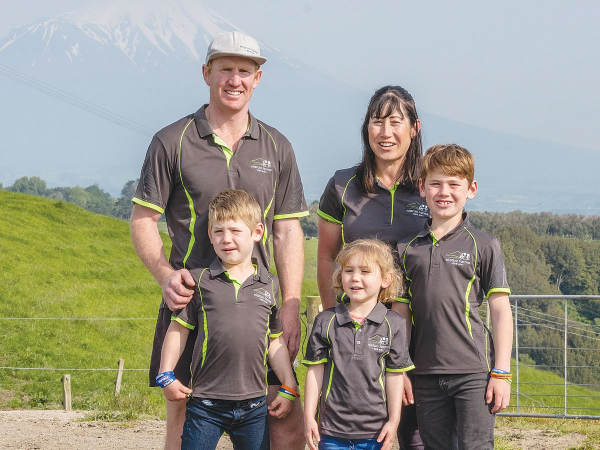
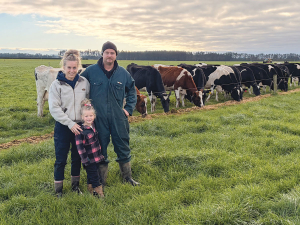
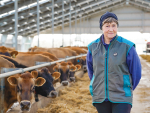
For Taranaki dairy farmers Hayden and Alecia Lawrence, DNA testing their herd has been a game-changer for their breeding programme and the profitability of their business.
Hayden and Alecia milk 400 cows on a 177-hectare farm in Hawera. Four years ago, they dipped their toes in the DNA-testing waters with CRV.
Their reasons for DNA testing were simple: their breeding decisions rely heavily on parentage accuracy, and they know the average industry mis-mothering error rate is high. Hayden explains: "We work hard to match calves with their mothers, but it's impossible to get it right all the time. Some farmers swear they never get a cow and calf mixed up, but it absolutely happens
"I'm breeding for specific traits into my cows, and to do that, I need to use the right genetics with the right cows. My decisions are entirely based on the parentage of the dam and the sire. If that's inaccrate, then so are my breeding decisions."
CRV myDNA product manager Anna Morrow says mismothering is an issue in the New Zealand dairy industry.
"Farmers put the calf to the wrong dam, and subsequently the wrong sire, 25% of the time.
"When that happens, the breeding values against those animals are inaccurate. Parentage mistakes then get fed into the national database, which doesn't help farmers make good breeding decisions.
"But it's an easy fix. A tissue punch from an animal's ear is all we need to analyse the DNA and run it against the whole database of sires. Once we do that, we can verify the correct sire and dam for an animal with very high accuracy."
After DNA testing their entire herd, Hayden and Alecia eliminated all doubt as to the parentage of their animals.
Having seen good results, they opted to finetune their breeding programme to allow them to target specific traits they needed to boost the performance of their animals. The next step was genomic testing.
Using the same ear tissue, genomic testing is a more accurate method of predicting the performance of an animal. As a DNA product manager, Anna understands how genomic provides clearer insights.
"A genomic test is a deeper dive into the DNA. With this test we can see the genetic markers that are responsible for specific traits within an animal. It adds an extra layer of accuracy to predicting the performance of an animal.
"A cow's performance is directly related to the genes inherited from its mum and dad. Parent average breeding values are calculated using 50% of each parent's genetic value. However, the portion of each trait coming from mum and dad differs. By looking at the DNA we may find that 80% of an animal's genes that express a trait have come from her mother and only 20% from dad. This will affect the breeding value for this trait and can move it up or down. This more reliable genomic information can dramatically change the breeding decisions a farmer makes."