Don't get caught short - have enough feed in the bank
OPINION: Few things are more stressful for dairy farmers than running out of feed when cows need it most.




 increase font size
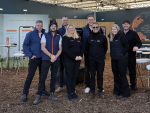
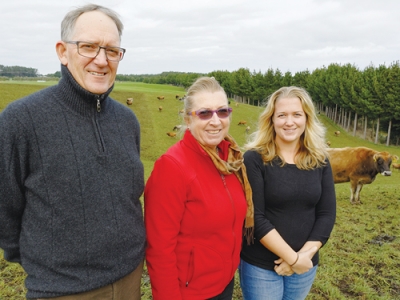 Taranaki farmers Robert and Verna Bourke with daughter Conna Smith.
Ensuring every calf goes into the herd at target weight makes sure a Patea, Taranaki, dairy farm is running at full capacity, even on once-a-day (OAD) milking, says calf feed maker Fiber Fresh.
Robert and Verna Bourke have milked 190 Jerseys OAD for 12 seasons, and production is now comparable to when they milked twice daily (TAD). Last season the farm set its OAD production record of 62,000kgMS, only 500kg off beating its TAD record.
Robert attributes this to genetics and growing animals to their potential in their first year. The farm rears 60 calves per season.
“Our big thing is quality and milking OAD has given us… time to monitor our animals carefully, so that none are coming into the herd underweight.”
That is why the Bourkes decided to switch to OAD milking.
“After 40 years of milking cows the traditional way, we were disillusioned. We saw OAD as giving us a new challenge, and it gave us a better lifestyle and enabled us to simplify our systems. But it also gave us the all important time to invest in our stock.
“That first year is critical if you want your calves to grow to full capacity; you can’t do it after that.”
The Bourkes’ daughter Conna and husband Nick have been lower order sharemilkers on the farm for three seasons and this season they are taking over fully as 50/50 sharemilkers.
Two extra pairs of hands means Robert and Verna can step back. “With four of us there’s always someone around and it creates more helpful discussion about the animals, their weights and where focus needs to be.”
Conna says this year’s heifers are the best the farm has ever seen, and that observers cannot distinguish the heifers from the cows.
“We give them a good start and keeping it going. I like to measure everything so we weigh the calves every month. Once they’re at weaning weight, we split the mob into three groups depending on their weight, so we can keep an eye on the little ones and make sure they’re getting the extra feed they need.
“This means we pick up the scrawny ones when they’re only two to four weeks behind, not 12 months down the track when it’s harder to do anything about it.”
Conna also introduced feeding milk TAD, from OAD last season for the calves’ first couple of weeks, to help capture those falling behind in the early days and ensure the growth of the animals’ skeletons.
“They were heavier because of it and they also took to feed much quicker. We feed Fiber Fresh Fiber Start from day one, along with milk, and then once they’re on pasture we use Fiber Gain.
“We ad-lib feed the smaller calves as much Fiber Gain as they can eat, to bring them up to weight. Often those that started out smaller will put on more weight per day than those in the bigger mobs. Some are six weeks younger, but they’re still at the same weight.”
Robert says having underweight heifers coming into a herd is huge unrealised value. “It comes straight out of your milk production.”
He first came across Fiber Fresh nine years ago and started using it because of its nutritional value and convenience.
“When we switched to OAD we also wanted to simplify our feeding systems. Fiber Fresh has everything needed to develop calves’ rumens, it’s scientifically based and it’s the only product we need to use in the shed or in the paddock, so it makes everything streamlined.”
Though budgets are tight in this season and the Bourkes will be monitoring their feed consumption closely, they don’t expect to make cuts to nutrition.
OPINION: Few things are more stressful for dairy farmers than running out of feed when cows need it most.

Cows ingesting metal objects in conserved feed is typically going to end in tears, quite often with a trip to the knacker’s yard.
Farmers are being urged to feed more milk to new-born calves.
A series of open days will run in the North Island this month on controlling feed intake of calves and heifers.
Nutrition consultant to AgriVantage, Natalie Chrystal on the role of whey-based milk replacers during calving.
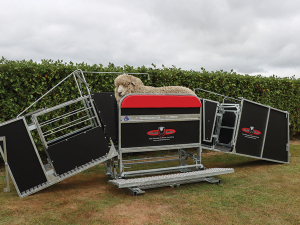
Oamaru-based livestock handling specialist Te Pari has bought Combi Clamp, the New Zealand manufacturer of Combi Clamp manual sheep handlers.

Agriculture Minister Todd McClay has admitted that a scheme bringing workers from Pacific nations to work on orchards has become too hard to navigate but says changes are coming.
A new app designed in New Zealand aims to help sheep, beef and deer farmers capture, analyse and use body condition score data more effectively.
Canterbury farmer Andy Macfarlane has been appointed to the board of AgriZeroNZ, the public-private partnership designed to accelerate the development and deployment of emissions reduction tools for New Zealand farmers.
For over 50 years Mel Ewers has been supporting the apple sector navigate through compliance and quality assurance issues.
The apple sector is enjoying a bumper harvest season.

OPINION: City and regional councils have been put on notice - stop using extreme climate forecasting scenarios that can drive…
OPINION: The Green Party’s rivers and oceans policy may have a new name but nothing else has changed.