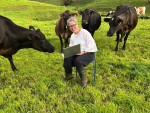
International Day of Rural Women: Two DairyNZ Farmers’ Stories
Today, 15 October, is the International Day of Rural Women, which recognises rural women’s contribution to farming, communities and the environment.




 increase font size
 Sean Daly.
Dr Sean Daly, vet and technical adviser at MSD Animal Health, explains best-practice guidelines for treating cows with clinical mastitis.
Mastitis is one of the most common diseases of New Zealand dairy cattle. Following best-practice guidelines for treating cows with clinical mastitis will maximise the chance of them curing and will ensure that milk entering the food chain is fit for consumption.
When you find signs of clinical mastitis, such as clots or flakes in the milk, watery milk, or a swollen, hard or painful quarter, follow MRS T: mark, record, separate then treat1,2.
First, mark the cow following the convention on your farm, so it is easy to see that she is being treated for mastitis. For example, spray her legs and udder with red spray paint. Then, record the date, the cow’s tag number and the quarter with mastitis in your permanent animal health records. You may want to also record it temporarily on the whiteboard in the shed so it’s easy to see. Next, separate the cow by either drafting her into the paddock with the red mob, or put her in a side pen or leave her on the platform until she can join the red mob so that her milk will be diverted away from supply.
If the cow is a repeat-offender, if you are having more mastitis than normal, or if you are monitoring mastitis closely on your farm, take a milk sample for bacterial culture before you milk the cow. These samples can be tested right away or be frozen and tested at a later date if the cow does not respond to treatment. The culture results from many samples over time can help you decide on the best mastitis treatments and can help you identify likely sources of new infections.
Once the cow has been marked, recorded, separated (and, if appropriate, sampled), she can be milked.
After milking, the cow is ready for treatment. You should have a treatment plan discussed with your vet before calving begins about which mastitis treatments to use, and when. Depending on how the mastitis presents, age of the cow, previous history of mastitis and how many quarters are affected you may have different treatment protocols. A decision-making flow chart is a useful tool that your veterinarian can provide to help you decide which treatments to use, and when. This can be hung on the wall next to the medicine cabinet for easy reference.
Hygiene and cleanliness are important. Most cases of clinical mastitis are treated by inserting antibiotic into the affected quarter. These intramammary antibiotics need to be administered cleanly and gently, so new infections are not introduced. First, wear clean and dry gloves. Next, use a new teat wipe or cotton ball soaked in meths to thoroughly clean the teat end. Uncap the tube and partially insert its tip into the teat end, no more than a few millimetres. Gently press the plunger to instil the product into the teat. If the product label says to strip or massage it up into the quarter, then, hold off the end of the teat with your clean fingers and use the forefinger and thumb of your other hand to move the product up. Lastly, spray the cow’s teats with teat spray.
It is important to record the treatments you’ve just given next to the cow’s information in your permanent animal health records and, if appropriate, also on the whiteboard. Make sure it’s clear how many more doses of treatment the cow should receive, and when. Double-check that the correct milk and meat with-holding periods are being followed with each case.
A few days later, when the cow finishes her course of mastitis treatments, she may still have an abnormal quarter or milk. Sometimes this is because the antibiotic hasn’t cured the infection, but more often, the antibiotic has killed the bacteria, but the inflammation is still resolving. If you have concerns about whether or not your mastitis treatments are working as well as they should be, discuss this with your veterinarian. These concerns are easiest to investigate if you have good permanent records from clinical cases.
Once the cow’s milk and quarter are back to normal and she has cleared her milk-with-hold, mark her to signal she’s okay to go back into the vat and then return her to the milking mob.
For more information about mastitis, speak with your vet, consult DairyNZ SmartSAMM resources, or visit www.TopFarmers.co.nz.
• Dr Sean Daly is a vet and technical adviser at MSD Animal Health
References
DairyNZ SmartSAMM. (2012). Lactation Technote 10: Rapidly find, record and treat clinical cases.
DairyNZ SmartSAMM. (2012). Calving Technote 4: Rapidly find, record and treat clinical mastitis in recently calved cows.
Today, 15 October, is the International Day of Rural Women, which recognises rural women’s contribution to farming, communities and the environment.

For years, New Zealand’s dairy sector has been moving towards more selective use of antibiotics at dry-off, yet blanket dry cow therapy (DCT) – treating every cow in the herd with antibiotics, regardless of her individual infection status – has persisted on some farms.
The first major update to the Dairy Cattle Code of Welfare in more than a decade has been released, marking what DairyNZ describes as an important step in ensuring animal welfare standards continue to evolve alongside scientific evidence and on-farm realities.
Have a plan in place for your cows and staff.
Bovine Viral Diarrhoea (BVD) is sometimes viewed as a dairy industry issue, but the reality is that the disease can have serious consequences for beef breeding herds as well.


Federated Farmers has welcomed new rural policies released by ACT, saying they align closely with its own election priorities.

Rural Contractors NZ says proposed changes to land transport rules for agricultural vehicles are a welcome response by the Government to out of date regulations which have seen members hit with huge fines.
Alliance is calling for final applications for its 2027 Graduate Programme, with applications closing on Sunday 25 October.
Decades piloting planes has ensured vet and farmer David Hayes is focused on safety. So, after a serious accident while welding on farm, he is sharing his experience so others can learn from it.
Canterbury milk processor, Synlait Milk has confirmed Leon Fung as its chief executive officer.
OPINION: Making it easier to collect rainwater and use it to grow crops and livestock is a no brainer.



OPINION: It seems Canterbury processor Synlait is still in the doldrums.
OPINION: Get offside with New Zealand First leader Winston Peters at your own peril.




