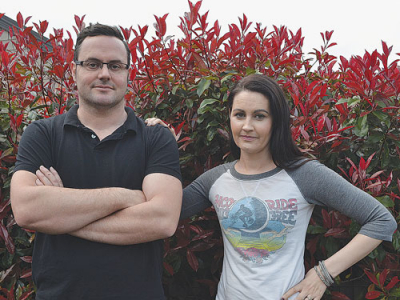
Hansen, who runs the Lilac Grove Jersey Stud at Fernside, near Rangiora, had bought four elite cows from an Australian breeder but was prevented from importing them because of the discovery of M.bovis in July.
By then the cows were in quarantine waiting to be flown across the Tasman.
Hansen has broken his silence over the dispute after MPI wrote to him on February 26 saying he would not be compensated.
Hansen bought the four cows in late May from the Kenarie Jersey stud at Murwillumbah, northeast NSW.
“We did our research and found we could import them if we did certain quarantine protocols. So we went and bought them, got them taken down to the quarantine farm and put through a couple of months of quarantine and extensive testing,” said Hansen.
“There was one final test and a plane trip to come, and we were told they could no longer come,” said Hansen.
“We were about seven days away from them leaving Australia to come to New Zealand.”
MPI’s Mycoplasma bovis response controller David Yard confirmed the import permit was denied because of the risks associated with the disease.
Hansen said he had spent $26,000 on the cattle and between $25,000 and $28,000 on the quarantine and testing.
The four cows tested clear for Mycoplasma bovis and a PCR test on the milk of the whole herd of origin had also tested negative, he said.
“They’ve probably been tested more than some of the herds they’ve declared free over here.”
In his claim for compensation, Hansen sought about $350,000. About $50,000 was for quarantine and other costs to date, but most of it was the estimated cost of having the four cows flushed of embryos which would then be brought across the Tasman to recipient cows here.
He believed the claimed amount was justified, in that the money would have ‘squared’ him up to the position he had anticipated had the cattle been able to come.
Hansen said that when the import was blocked MPI invited him to make a claim and indicated it would be considered “on moral grounds”.
“We put that in expecting to get paid in a month or two then it dragged on and on. We expected we would at least get compensated for our quarantine costs.”
He has now asked for MPI’s complete file on his case. “When I’ve got that in my hands we may talk to lawyers but it depends how much money we want to throw at it.”
It is believed it would have been the first import of live cattle in about four years and the first of Jerseys in about 30 years.
“What frustrated me a bit was they were some new genetics which the dairy breeds sorely need in New Zealand. That was a big motivation for bringing them in,” said Hansen.
The cows are bigger than NZ Jerseys. “They’ve got an elite type. Their udders and frames were very true and correct and their production was extremely impressive as well.”
One had recorded 700 - 800kgMS, which Hansen said is about double the Jersey average in NZ.
The cows are now being held by friends of Hansen on a stud at Tamworth, where they have calved and are being milked.
Still hoping
Peter Hansen still hopes to import his Jerseys from Australia but says it may be too late if matters are not sorted in six to12 months.
Meanwhile, imports of semen and embryos were still allowed.
“I’ve got to get the OK from MPI to be able to flush them, so that’s up in the air too. If and when we get the OK to do that we still plan to flush them and hopefully bring their genetics in like that.”
Hansen said people in Australia and NZ had been excited the importation was happening, and to get knocked back was “pretty disappointing”.
He believes semen or clothing are the more likely sources of the Mycoplasma bovis outbreak, rather than live cattle.
Hansen, who also runs a drainage contracting business, took over the Lilac Grove Stud on the retirement of his grandfather, who set up the business in 1936.
Taxpayers money at issue
MPI said in a prepared statement that Hansen’s compensation claim was declined because eligibility criteria were not met.
MPI’s director, animal and animal products, Paul Dansted, referred to criteria detailed in section 162A of the Biosecurity Act.
“This is taxpayers’ money and this is the key test. Compensation is only paid for verifiable losses as a result of MPI exercising its powers under the Biosecurity Act for the purpose of control or eradication of an organism.
“None of these powers were exercised on Mr Hansen. According to the Act, ‘compensation must not be paid if the person’s loss relates to uncleared goods’. The cattle concerned were not cleared and were not in New Zealand.”
Dansted said the Import Health Standard was suspended as a precautionary measure. The suspension was not an exercise of powers to control or eradicate the disease; it was a measure to prevent any further introduction of it while management measures took place.
He added that the import permit documentation made it very clear that a permit did not guarantee the animals would be given biosecurity clearance. The animals still needed to satisfy the provisions set out in the Import Health Standard, which could change rapidly.
“This is what occurred in this instance,” he said.
When the IHS was suspended, the cows had not then met all the IHS requirements and the Australian authorities had not issued them an export certificate, said Dansted.
Nor had MPI received confirmation from the Australian authorities that the cows were negative for Mycoplasma bovis, as claimed.
Dansted denied that Hansen received an assurance regarding compensation.
“MPI officials had advised him he was able to submit a claim for compensation, but did not say he would receive it.”