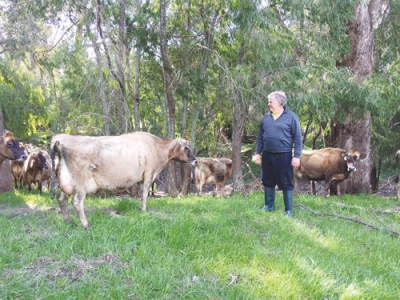
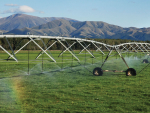
The flood irrigated pastures of Mike MacLaughlin's Western Australian farm are a "real money spinner" despite the salty water.
The farm's irrigation water dam has high salt levels, consistently above 1100 ppm. Anything over 600 ppm is said to damage clover pastures but with water being cheap it's working out well.
"Our milk price is 30% higher during December-May, making the flood irrigated pastures a real money spinner," MacLaughlin said.
The water is cheap because nobody wants it. "I recently bought 180 megalitres of extra permanent water allocation for $180," MacLaughlin says. "We pay around $60/ML for water delivered on farm."
The salt content of the water was analysed and found that it applies 2400kg of sodium chloride and 700kg of magnesium chloride per hectare each year.
"We over-water at each application to remove any soluble salts that have accumulated on the soil surface when water evaporates," MacLaughlin says.
The farm applies five tonnes of gypsum/ha each year to reduce the damage caused by excess magnesium.
The applied sulphur converts magnesium to highly soluble Epsom salts which washes out of the soil and the released calcium helps to balance the calcium/magnesium exchangeable cation ratio. "We then only need to apply potassium to grow huge volumes of pasture," he said.
The pastures are mostly self-sown kikuyu and white clover with a good dose of fiddle dock and perennial rye.
The 30ha of irrigated pasture is divided into 36 fixed paddocks, one being grazed each day of the year in a fixed rotation. Milking cows graze in summer and then young stock graze in winter to prevent pugging.
The herd is offered the whole paddock each day close to midday when sugar levels in the plants are highest. They remain on the same pasture for 24 hours to take advantage of the higher sugar content of kikuyu stems that fill with mobilised reserves in preparation for new leaf growth.
Nitrogen applications are kept to a minimum, giving the clover a head start with its own N fixing process and forcing the kikuyu to scavenge for any surplus N being excreted by the cows.
MacLaughlin says the long grazing interval forces the kikuyu to lift its growth points above the ground as it starts to shade itself – something clover never does – causing maximum damage to the kikuyu plants when grazed.
Last December, near the peak of the growing season, MacLaughlin said he measured the pasture at 36 days regrowth and found it had grown 3.4 t DM/ha with an average crude protein content of 24.9% and metabolisable energy level of 12.1 MJ/kg.
Measured again at 42 days they had grown 4.4 tonnes of DM/ha with an average crude protein content of 15.6% and metabolisable energy level of 9.8 MJ/kg.
They can run six milking cows and followers per hectare on the irrigated pasture and harvest 2t/ha MS.
"We have measured 22t DM growth per hectare and at the same time harvested 25t DM when measured at the vat outlet," MacLaughlin says.
He attributed his ability to harvest more than they grew to feeding at peak pasture sugar levels and having efficient feed conversion through the cows.