Federated Farmers Welcomes ACT’s New Farming Policies
Federated Farmers has welcomed new rural policies released by ACT, saying they align closely with its own election priorities.




 increase font size
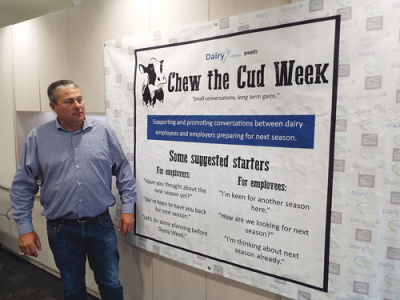 Matt Jones, NZ Dairy Careers managing director.
Employers aren't paying enough attention to retaining the employees they have for the next season.
The scale of the New Zealand dairy industry is seen in the numbers: revenue of $14 billion, 12,000+ farmers and 34,000+ employees.
Then look at the negative side of the ledger: the industry is consistently 7% understaffed and has about 900 vacancies at any time.
So why do employers pay insufficient attention to retaining the employees they have for the next season?
This and other questions arose at recent ‘Chew the Cud’ meetings at Ashburton and Te Awamutu, run by the recruitment company NZ Dairy Careers and supported by DairyNZ, Federated Farmers and Fonterra Farm Source.
The aim was to encourage dairy employers and employees to start talking about the following season much earlier in the preceding season rather than just before Gypsy Week, so removing uncertainty – for both parties – about whether an employee would stay or go.
Employers are often afraid to broach the stay/go issue, the anecdotal evidence showed. And a typical worker review might go something like, “How ya doing?”, bringing a response, “Yeah, good.”
The ‘Chew’ meetings urged employers, especially, to start talking sooner rather than later.
An employer might say, “Have you thought about next season?” or “We’re keen to have you back next season” or “Let’s do some planning before gypsy week.”
The employee then hopefully responds, “I’m keen to come back for another season” or “I’m looking at next season already.”
NZ Dairy Careers managing director Matt Jones says many employers feel awkward about initiating conversations about where employees are heading, so they keep putting them off.
“We understand that starting a conversation may be difficult, more so if it’s about an employee staying or leaving. The fact is, the management of your business needs plans to be made early because in April/May the best employees have been snapped up or someone you are happy with has arranged to leave, solely because nobody’s discussed it.”
Facilitators at the ‘Chew the Cud’ meetings proposed a framework of relevant questions that both parties should be asking to ease everyone into conversation. Typical subjects could be career development for an employee or areas of weakness needing work, with help from the employer or outside agencies.
Salary or remuneration packages, often a difficult subject, shouldn’t be overlooked, especially given that an employee may find it more difficult to discuss this with a current employer than with a prospective employer.
Diary those talks for the early part of the year, was the advice.
Federated Farmers has welcomed new rural policies released by ACT, saying they align closely with its own election priorities.
Federated Farmers is backing Feilding High School’s call to keep Agriculture and Horticultural Science as a standalone subject in Year 11.
National’s pledge to introduce 19 new national standards shows the party is serious about getting Wellington out of farming, Federated Farmers says.
Today, 15 October, is the International Day of Rural Women, which recognises rural women’s contribution to farming, communities and the environment.
Mobile phone coverage and reliability are deteriorating in rural areas, and farming families are bearing the cost, according to a Federated Farmers survey.


Federated Farmers has welcomed new rural policies released by ACT, saying they align closely with its own election priorities.

Rural Contractors NZ says proposed changes to land transport rules for agricultural vehicles are a welcome response by the Government to out of date regulations which have seen members hit with huge fines.
Alliance is calling for final applications for its 2027 Graduate Programme, with applications closing on Sunday 25 October.
Decades piloting planes has ensured vet and farmer David Hayes is focused on safety. So, after a serious accident while welding on farm, he is sharing his experience so others can learn from it.
Canterbury milk processor, Synlait Milk has confirmed Leon Fung as its chief executive officer.
OPINION: Making it easier to collect rainwater and use it to grow crops and livestock is a no brainer.


OPINION: It seems Canterbury processor Synlait is still in the doldrums.
OPINION: Get offside with New Zealand First leader Winston Peters at your own peril.




