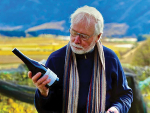
Alan Brady: Central Otago's Pinot Noir Pioneer at 90
Having founded three wineries, sold two, and put the 21st vintage of Wild Irishman into barrel, Central Otago winemaking pioneer Alan Brady could choose to put his feet up.




 increase font size
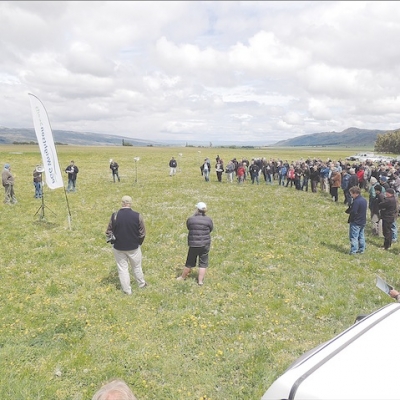 Delegates on a field trip.
DAIRY FARMS are few and far between in Central Otago but the New Zealand Grassland Association’s 76th annual conference in Alexandra last week still had plenty of papers relevant to the sector, and not just in the session designated dairy.
The rising star of forage crops – fodder beet – featured in three papers and several of the environmental research works reported related to dairy. For instance, Iris Vogeler’s presentation headed ‘Effects of fertiliser management on nitrate leaching risk from grazed dairy pastures’.
By modelling losses over 20 years, Vogeler and Agresearch colleagues Mark Shepherd and Gina Lucci conclude, “…risk of direct leaching from applied fertiliser was generally low, but at an annual rate of 220kgN/ha exceeded that from urine patches in one out of 10 years”, confirming the general wisdom that it’s when the nitrogen gets concentrated into urine patches that most losses occur in most years.
Among the usual solutions of avoiding fertiliser use during high leaching risk periods based on soil moisture and plant growth, they suggest using “duration controlled
grazing”, ie on-off systems, to prevent excreta deposition on pasture at critical times from an N loss perspective.
Their work used the Agricultural Production Systems Simulator which factors actual weather data rather than the long-term averages written into Overseer’s calculations.
On the fodder beet front, Gavin Milne of DLF Seeds presented results from trials in Mid Canterbury, North and South Otago, and Southland, showing that in 2012-13 there was nothing to choose between the top five of the seven cultivars tested across all four sites – Enermax, Magnum, Bangor, Troya and Kyros all coming in with 17.4-19.4tDM/ha yields, while Feldherr and Brigadier did 15.2 and 14tDM/ha respectively.
While they were grown only at three of the four sites, yields of Suga and Energaci were also up there with the top five, reflecting their high dry matter contents averaging 22.6% and 19% respectively. Both are listed as lifting, not grazing types in the paper, as are Enermax and Magnum. Bangor, Troya and Kyros get ticks in both boxes thanks to dry matter content of 17.5%. Feldherr and Brigadier’s dry matters were 15.4% and 13.6% respectively.
Large turnout thrills mayor
CENTRAL OTAGO is one of the least densely populated districts in New Zealand but last week’s Grassland Association conference still attracted about 360 delegates.
“Alexandra is completely full,” said mayor Tony Lepper opening the conference. “When you bring in 360 people like this it really stretches our town but we’re not complaining: it’s great to be full.”
Roughly a third of delegates were from research organisations, a third from commercial companies and a third farmers, said organisers.
“We have over 20 students registered this year which is fantastic for the future of NZGA,” said association president Warwick Lissaman.
More from the conference, including a powerful presidential address from Lissamann and evidence that many dairy farms miss grazing management targets, in 18 November Rural News.
Having founded three wineries, sold two, and put the 21st vintage of Wild Irishman into barrel, Central Otago winemaking pioneer Alan Brady could choose to put his feet up.
Sir Sam Neill made an extraordinary mark on the world, and on the world of New Zealand wine.
OPINION: New Zealand's soils and climate make our wine industry extraordinary. But it is the people behind the vines and wines who make it Altogether Unique.
A new app designed in New Zealand aims to help sheep, beef and deer farmers capture, analyse and use body condition score data more effectively.
Carolyn Murray, general manager of Central Otago Winegrowers Association, says collaboration remains Central Otago's secret weapon.


Federated Farmers says it welcomes Labour's commitment to reviewing the Sharemilking Agreements Act, calling on other major parties to do the same.
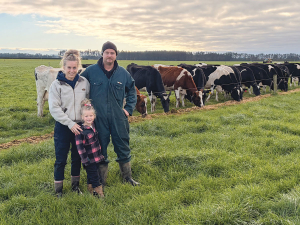
For Canterbury dairy farmers Sian Meijer and Rick Wobben, wearable technology has become one of their most valuable on-farm tools - helping manage 1850 cows across an expansive, high-performing dairy operation while improving efficiency, mating outcomes and day-to-day decision making.
Fonterra has unveiled its annual results for the 2026 financial year, posting $27 billion in revenue and close to $20 billion returned to New Zealand farmer owners and unit holders.
The first major update to the Dairy Cattle Code of Welfare in more than a decade has been released, marking what DairyNZ describes as an important step in ensuring animal welfare standards continue to evolve alongside scientific evidence and on-farm realities.
Ravensdown shareholders have elected Jane Montgomery and Kate Acland to the Ravensdown Board for three-year terms, following a closely contested director election.
Federated Farmers says new legislation replacing the Resource Management Act will cut red tape, unlock investment and help grow New Zealand's export-led economy, after the Planning Bill and Natural Environment Bill passed their third reading in Parliament yesterday.


OPINION: It seems Canterbury processor Synlait is still in the doldrums.
OPINION: Get offside with New Zealand First leader Winston Peters at your own peril.




