Fonterra Elections 2026: Voting Opens Tuesday 20 October
Fonterra shareholders can begin voting on Tuesday 20 October in the 2026 Board of Directors’ election, a Co-operative Council election in one Ward, and seven Annual Meeting resolutions.




 increase font size
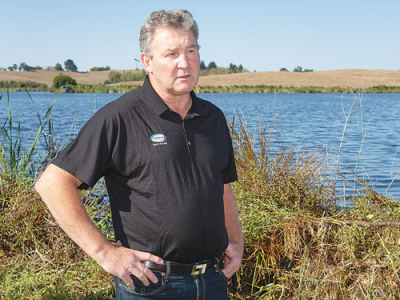 John Monaghan.
Persistently strong global milk supply forced Fonterra to cut its milk price forecast last week by about 20-25 cents.
The season’s farmgate milk price range is now $6 - $6.30/kgMS — down from $6.25 - $6.50/kgMS. The co-op is maintaining its forecast earnings per share range of 25-35 cents.
It also confirmed it is negotiating to take back full ownership of the Darnum plant in Australia and is looking at selling Tip Top, although it wants it to remain a New Zealand business.
Fonterra chairman John Monaghan says the revision is due to the global milk supply remaining stronger relative to demand, which has driven a downward trend on the Global Dairy Trade (GDT) index since May.
“Since our October milk price update, production from Europe has flattened off the back of dry weather and rising feed costs. US milk volumes are still forecast to be up 1% for the year,” says Monaghan.
“Here in NZ we are maintaining our collections forecast of 1550 million kgMS. NIWA is saying it’s likely we will see an abnormal El Nino weather pattern over summer and this could impact our farmers’ milk production.
“Demand from China and Asia remains strong. However geopolitical disruption is impacting demand from countries that traditionally buy a lot of fat products from us.”
Fonterra chief executive Miles Hurrell says the latest forecast assumes demand will firm during the balance of the season, in line with predictions by other market commentators.
“Unknowns [persist] in the global demand and supply picture and we recommend farmers budget with ongoing caution. Fonterra’s advance rate has been set off a milk price of $6.15/kgMS.”
Fonterra’s first quarter gross margin of $646 million is down $14m versus the same period last year and up slightly on a percentage basis from 16.6% to 17%. Revenue of $3.8 billion is down 4% and sales volumes were down 6% to 3.6b liquid milk equivalent (LME).
The co-op’s ingredients business, despite lower sales volumes, performed solidly during the first quarter with a gross margin of $273m, up $28m on last year. The consumer business also performed well with a gross margin of $310m, up $10m on last year and volumes were up 5%.
Hurrell says the co-op generally makes a smaller proportion of its total annual sales in the first quarter. “This means the results from the first quarter do not give much insight into earnings performance for the full year.”
Fonterra shareholders can begin voting on Tuesday 20 October in the 2026 Board of Directors’ election, a Co-operative Council election in one Ward, and seven Annual Meeting resolutions.

Fonterra Co-operative Group chief financial officer Andrew Murray has resigned to take up a role outside the dairy giant.
Four candidates have been confirmed for two director positions on Fonterra’s board.
A record farmgate milk price and strong global demand is laying the foundation for continued growth of organic dairy farming in New Zealand.
Waikato milk processor Tatua has again declared a record milk payout to farmer shareholders, leaving other processors in the dust.


Mark Hooper has been appointed the new chair of NZPork, the industry organisation representing New Zealand pig farmers.

As the India-New Zealand free trade agreement enters into force, New Zealand’s apple industry has reaffirmed its commitment to the long-term development of India’s apple sector.
Fonterra shareholders can begin voting on Tuesday 20 October in the 2026 Board of Directors’ election, a Co-operative Council election in one Ward, and seven Annual Meeting resolutions.
National’s pledge to introduce 19 new national standards shows the party is serious about getting Wellington out of farming, Federated Farmers says.
The National Party’s policies to make it easier to grow fresh vegetables, secure reliable water and energy and simplify farm planning are practical changes that will give growers the confidence to invest, according to Horticulture New Zealand (HortNZ).
Fonterra Co-operative Group chief financial officer Andrew Murray has resigned to take up a role outside the dairy giant.


OPINION: It seems Canterbury processor Synlait is still in the doldrums.
OPINION: Get offside with New Zealand First leader Winston Peters at your own peril.




