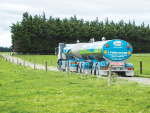
Fonterra FY26 Results: $9.69 Milk Price, $3.4bn Profit
Fonterra has unveiled its annual results for the 2026 financial year, posting $27 billion in revenue and close to $20 billion returned to New Zealand farmer owners and unit holders.




 increase font size
 Chief executive Miles Hurrell.
Fonterra says its improved milk price reflects strong global demand relative to supply.
The co-op is forecasting a farmgate milk price of $6.30-$6.60/kgMS.
Chief executive Miles Hurrell told a media briefing last week that good demand for ingredients was coming from Asia, including Greater China.
On the supply front, milk growth has slowed due to trying weather in some large milk producing regions.
Australia’s milk production is forecast to be down 7-9% on last season due to drought; in the EU, growth has slowed and is forecast to be less than 1% on last year.
Hurrell says for Fonterra farmers, the strong dry weather has also impacted milk production.
The co-op two weeks ago downgraded its milk forecast for the season from 1530 million kgMS to 1510 million kgMS for 2018-19. This is slightly above last season’s collections of 1505 million kgMS, a season also impacted by poor onfarm conditions.
Hurrell notes that milk price is an important metric for the co-op. “We are owned by 10,000 farming families and their livelihood depends on the milk price.”
Fonterra is promising farmers more accurate forecasting -- a tough task given volatility in weather and geopolitics. “This makes forecasting difficult; that’s why we have resorted to ranges in our forecast,” Hurrell says.
Hurrell last week outlined the priorities for the co-op for the second half of the 2018-19 financial year: to meet the earnings guidance, deliver on the three-point plan and fundamentally reset the business so it can achieve sustainable earnings.
“We have a forecast farmgate milk price of $6.30-$6.60/kgMS but we also have to meet our earnings guidance range of 15-25 cents per share,” says Hurrell.
Fonterra’s three-point plan involves taking stock of the business and reviewing its business portfolio, getting the basics right and improving its forecasting.
“We’ve made good progress so far and we will continue to take these steps in the second half to firm up our foundations and strengthen our balance sheet,” says Hurrell.
“The second half will also see us continuing the work on developing a new strategy to support a much-needed change in direction. We are doing the right things but it’s clear more is needed to lift our performance. We need to simplify and improve the co-op so we can grow value.”
Fonterra has unveiled its annual results for the 2026 financial year, posting $27 billion in revenue and close to $20 billion returned to New Zealand farmer owners and unit holders.
Fonterra Co-operative Group has confirmed the independently assessed candidates standing for election to its board in 2026.
Fonterra has revised its Farmgate Milk Price forecast for the 2026/27 season, lifting the midpoint and narrowing the range on the back of improving global dairy commodity prices.
Outgoing Fonterra Co-operative Council chair John Stevenson says that it has been a privilege to represent the co-op's farmer shareholders.
OPINION: It seems Canterbury processor Synlait is still in the doldrums.



LIC shareholders have elected a new North Island representative to the co-operative's Board, along with five representatives to its Shareholder Reference Group (SRG), following the company's Annual Meeting held in Invercargill.
Farmers across parts of Southland and South Otago are continuing to deal with difficult conditions after a prolonged run of wet weather, with pressure building around feed supply, stock management, pasture damage, farm infrastructure and everyday workloads.
Federated Farmers says it welcomes Labour's commitment to reviewing the Sharemilking Agreements Act, calling on other major parties to do the same.
For Canterbury dairy farmers Sian Meijer and Rick Wobben, wearable technology has become one of their most valuable on-farm tools - helping manage 1850 cows across an expansive, high-performing dairy operation while improving efficiency, mating outcomes and day-to-day decision making.
Fonterra has unveiled its annual results for the 2026 financial year, posting $27 billion in revenue and close to $20 billion returned to New Zealand farmer owners and unit holders.
The first major update to the Dairy Cattle Code of Welfare in more than a decade has been released, marking what DairyNZ describes as an important step in ensuring animal welfare standards continue to evolve alongside scientific evidence and on-farm realities.




OPINION: It seems Canterbury processor Synlait is still in the doldrums.
OPINION: Get offside with New Zealand First leader Winston Peters at your own peril.




