Fonterra FY26 Results: $9.69 Milk Price, $3.4bn Profit
Fonterra has unveiled its annual results for the 2026 financial year, posting $27 billion in revenue and close to $20 billion returned to New Zealand farmer owners and unit holders.




 increase font size
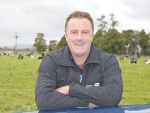
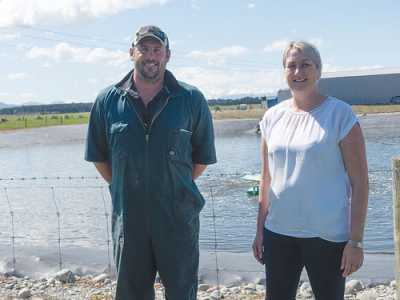 The Pye Group’s Michelle Pye (right) with farm manager James Emmett.
Economic and social sustainability must go hand-in-hand with environmental sustainability, says the only farmer member of the recently named Fonterra sustainability advisory panel.
“Whenever you see ‘sustainability’ you always think environmental firstly, and probably for good reason,” says South Canterbury’s Michelle Pye. “But you know they’re interlinked; you can’t have one without the others.
“Sustainability is about having our business here long-term, for generations to come. And you need financial sustainability, environmental sustainability and social sustainability because you need your licence to operate.”
Pye has been a member of the Fonterra shareholders council for two years. She is joined on the sustainability panel by five experts mostly from business and environmental management and with little prior connection to Fonterra.
“It’s an impressive group and I don’t profess to be an expert on sustainability at all but it’s important to have a farmer voice at that table and that’s my role there,” says Pye.
“You could loosely describe them as friendly critics. They’re there to challenge what you’re doing. In any industry you’ll get the biggest challenges from outside your industry. So it’s going to be interesting.”
Pye and her husband Leighton own and run the Pye Group at Winchester, across the road from the house where Leighton grew up. The group runs contracting and cartage businesses, and grows potatoes, carrots, cereals and seeds on 2000ha, mostly in the Rakaia area. It expanded into dairying in 2002 and now owns nine dairy farms, mostly south of the Rangitata River, managed by contract milkers.
“I am excited to be part of [the panel] because with Pye Group we want to have a sustainable business that’s respected in the community. But you’ve got to earn that respect and I’d like to see Fonterra do the same thing... and respected in New Zealand; what’s good for Fonterra will be good for New Zealand,” says Pye.
“I am a strong believer in the co-op model being what the industry needs. Without a strong co-op at the corner of the dairy industry in New Zealand I think we’d have serious concerns about profitability and sustainability.”
Pye says that having grown on the milk boom the Pye Group is now improving what they’ve got through sustainability, planting, and technology.
Their farms have few waterways, but they have done riparian and other planting where appropriate. A corner of one farm has been set aside as a habitat for native lizards.
Technology such as soil moisture probes and flow meters have become general practise in Canterbury, she says.
“A lot of our sustainability is in the use of water and fertilisers, so in that regard we measure and measure and measure.”
The group has bought its own fertiliser spreaders with proof-of-placement technology.
They have variable rate irrigation on two farms.
“We’d love to have it on every farm but it’s about $50,000 an irrigator,” she says. “That’s why I keep saying you’ve got to have environmental sustainability with economic sustainability.”
Their contracting business is a district collection point for a silage wrap recycling scheme.
The group has introduced “Pye group values” to ensure farm managers are clear about expectations and get “a huge amount” of support to meet them.
“It’s absolutely not acceptable to be non-compliant on any consent; that’s just a big no, and they know that,” says Pye.
They run a program called CSVue which manages all consents, sends alerts when actions are required, and logs effluent and irrigation ponds to help detect any problems.
The group already has close to 40 core staff (excluding farm staff employed by the contractors) but is about to appoint someone just to manage environmental compliance. All group farms either have a farm environment plan or are in the process of formulating a plan.
Fonterra has unveiled its annual results for the 2026 financial year, posting $27 billion in revenue and close to $20 billion returned to New Zealand farmer owners and unit holders.

Fonterra Co-operative Group has confirmed the independently assessed candidates standing for election to its board in 2026.
Fonterra has revised its Farmgate Milk Price forecast for the 2026/27 season, lifting the midpoint and narrowing the range on the back of improving global dairy commodity prices.
Outgoing Fonterra Co-operative Council chair John Stevenson says that it has been a privilege to represent the co-op's farmer shareholders.
OPINION: It seems Canterbury processor Synlait is still in the doldrums.


Federated Farmers says it welcomes Labour's commitment to reviewing the Sharemilking Agreements Act, calling on other major parties to do the same.
For Canterbury dairy farmers Sian Meijer and Rick Wobben, wearable technology has become one of their most valuable on-farm tools - helping manage 1850 cows across an expansive, high-performing dairy operation while improving efficiency, mating outcomes and day-to-day decision making.
Fonterra has unveiled its annual results for the 2026 financial year, posting $27 billion in revenue and close to $20 billion returned to New Zealand farmer owners and unit holders.
The first major update to the Dairy Cattle Code of Welfare in more than a decade has been released, marking what DairyNZ describes as an important step in ensuring animal welfare standards continue to evolve alongside scientific evidence and on-farm realities.
Ravensdown shareholders have elected Jane Montgomery and Kate Acland to the Ravensdown Board for three-year terms, following a closely contested director election.
Federated Farmers says new legislation replacing the Resource Management Act will cut red tape, unlock investment and help grow New Zealand's export-led economy, after the Planning Bill and Natural Environment Bill passed their third reading in Parliament yesterday.



OPINION: It seems Canterbury processor Synlait is still in the doldrums.
OPINION: Get offside with New Zealand First leader Winston Peters at your own peril.




