
Feds Back National’s 19 Farming National Standards
National’s pledge to introduce 19 new national standards shows the party is serious about getting Wellington out of farming, Federated Farmers says.




 increase font size
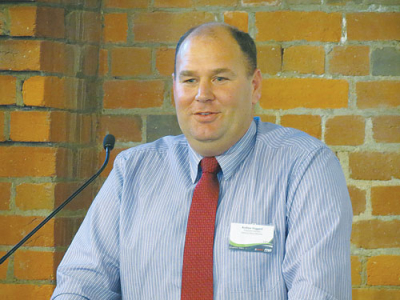 Andrew Hoggard at the Feds annual conference in Wellington last week.
Federated Farmers dairy section chair Andrew Hoggard has stepped down after three years in the role -- but not before firing a broadside at Greenpeace in his final speech last week.
He criticised Greenpeace’s Twitter campaign against dairying and its attack on DairyNZ board member Ben Allomes for talking about school bullying of dairy farmers’ children simply because of their parents’ occupation.
Hoggard says he invited Greenpeace members to visit his farm to see the issues he faces and discuss them, but they never took up his offer.
“To me Greenpeace seems to exist for one reason only -- to raise funds to provide employment for the people employed in it and provide them with trips to Italy so they can tweet from Rome.”
He says if farmers and Fonterra and DairyNZ challenge Greenpeace they are likely to be portrayed as corporate bully boys.
Hoggard addressed the usual issues of weather, the environment and compliance with employment agreements, then he took a strong line on how dairy farmers are portrayed in mainstream news media. Most provinces raised this matter during the conference, repeatedly discussing what might or could be done to enable farmers to get their good news stories out to the public. Some discussed using social media to talk directly to the public, by-passing conventional news media.
Hoggard suggested some recent research shows the public do not view dairy farming as badly as farmers may think.
He singled out animal welfare, the environment and employment as issues facing NZ farmers.
On the international front he warned that animal rights activists and environmentalists are pushing the green message and are saying people can get all the vitamins they need from lentils and tofu.
And not only hippies are opposed to farming, Hoggard says. Some big business people are lobbying hard against so-called factory farming.
“We’re too busy trying to jump on other farmers to get a bigger slice of the pie and are missing the point that the pie itself is at risk of, at least, being reduced in size.
“I sometimes wonder whether UK sheep farmers spend any time on their land. It seems to me they spend their time going to supermarkets to find NZ lamb chops to photograph so they can complain about them on Twitter; meanwhile lamb consumption there plummets.”
Hoggard says he’s perturbed about the attacks by some NZ lobby groups on irrigation; their criticism is unjustified if not over-the-top.
“Irrigation has been a favourite target for many of these groups because they link it to an increase in dairy and thus an increase in N run-off, so their catch-cry is ‘let’s scrap the government funding of irrigation schemes’ -- or subsidies, as they like to call them.
“Lets be clear: these are not subsidies, rather they are part of a contestable fund there to enable the start-up of projects which in the end have to stand financially on their own two feet.”
Hoggard says irrigation schemes should be treated like any other piece of infrastructure in NZ, such as roads. He says many roads in NZ he will never use, but he is happy to pay the tax used to build them and the same philosophy should apply to irrigation schemes.
Irrigation is vital to food production in NZ and is an insurance policy against drought.
Hoggard says people must understand that irrigation benefits all agriculture, not just dairying.
Lewis now heads dairy
Former Waikato Federated Farmers president Chris Lewis is the new chairman of the dairy section.
Wayne Langford and Jacqui Hahn are the vice-chairs and Richard McIntyre and Renee Rooney executive members.
Andrew McGiven replaces Lewis as Waikato Feds president.
National’s pledge to introduce 19 new national standards shows the party is serious about getting Wellington out of farming, Federated Farmers says.
OPINION: Rivers never sit still. They start as snowmelt and rain in the high country, pick up a creek here and a stream there, and carry all of it down to where it's needed.
Mobile phone coverage and reliability are deteriorating in rural areas, and farming families are bearing the cost, according to a Federated Farmers survey.
Central Otago District Council (CODC) has voted against a plan to spread treated sewage sludge from Cromwell and Alexandra on farmland near Lauder, a decision Federated Farmers says reflects strong opposition from rural residents.
Federated Farmers has called on Central Otago District Council (CODC) to drop or vote down a plan to truck sludge from Alexandra and Cromwell to farmland near Lauder, warning it would compound an "outrageous" situation created by a separate council's decision weeks earlier.


National’s pledge to introduce 19 new national standards shows the party is serious about getting Wellington out of farming, Federated Farmers says.
The National Party’s policies to make it easier to grow fresh vegetables, secure reliable water and energy and simplify farm planning are practical changes that will give growers the confidence to invest, according to Horticulture New Zealand (HortNZ).
Fonterra Co-operative Group chief financial officer Andrew Murray has resigned to take up a role outside the dairy giant.
A major move is about to get underway to improve the quality and viability of dairy beef and cattle in NZ.
Veterinarians say changes to the code of welfare for dairy cattle provides a positive foundation for improved cattle welfare across the country.
Today, 15 October, is the International Day of Rural Women, which recognises rural women’s contribution to farming, communities and the environment.




OPINION: It seems Canterbury processor Synlait is still in the doldrums.
OPINION: Get offside with New Zealand First leader Winston Peters at your own peril.




