Rural Vote Debate on Q&A: Substance or Just Platitudes?
It was billed as a chance for all the political parties to woo the rural vote, but question marks hang over just how effective this was.




 increase font size
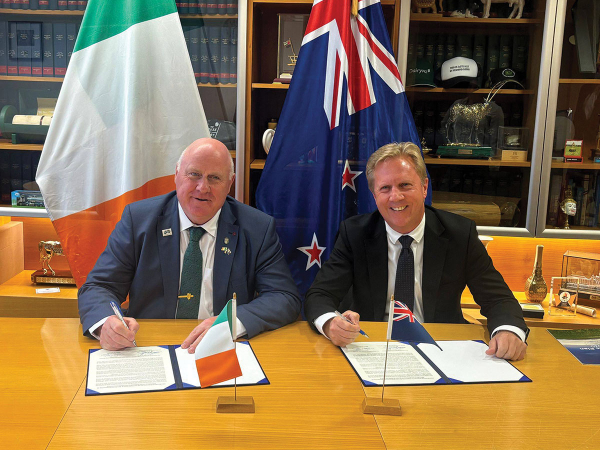 Irish Minister of state for Agriculture, Noel Grealish (left) and NZ Ag Minister Todd McClay in Wellington this month.
Ireland's Minister of state for Agriculture says it’s hard to explain to Irish farmers the size and scale of NZ farms.
Noel Grealish was in NZ recently to meet with Irish people as they celebrated St Patrick’s Day. Every St Patrick’s Day Ireland sends one of its politicians to countries all around the world to be with Irish people and those with Irish heritage. One in six New Zealanders have Irish heritage.
But aside of the St Patrick’s Day celebrations, Grealish who represents the West Galway region in Ireland, visited farms in both the North and South Islands, agricultural universities and research centres and also met industry and Ministry for Primary Industries (MPI) officials and Minister for Agriculture, Todd McClay. Travelling with Minister Grealish was Dr Karl Walsh the Head of Research, Bioeconomy and Codex in the Irelands Department of Agriculture, Food and the Marine.
This was Grealish’s first official visit to the country and he says while NZ and Ireland have a lot in common in terms of agriculture, the size of farms here is vastly different.
“We have 133,000 farmers in Ireland and that is a lot more than what you have,” he says.
Just take dairy as an example – Ireland has 16,000 dairy herds, the average herd size is 98 cows, and Ireland produces about 8.3 billion of litres of milk annually. Conversely NZ has 10,700 dairy herds, the average herd size is 449 and produce 21.1 billion litres of milk annually.
Grealish says he visited a huge farm near Christchurch which had a mix of dairy, sheep forestry and honey and he says the scale was something that you would never see in his country. The other thing that Grealish noted was the absence of subsidies for farmers in NZ.
“The reverse is the case in Ireland where farmers there get a lot of grants. In fact, you nearly get a grant just to get out of bed,” he says.
Grealish says farm payments are the biggest budget item in the European Union but he says this is likely to change in the near future with money being diverted to beefing up security and defence in the EU.
But while in NZ, Grealish was also concerned about the middle east crisis and its effect on Irish agriculture. He says they sell a lot of products in the Middle East and this is flown in on one of eight special flights every day. But he notes these flights have now stopped and one of the first jobs he’ll have when he gets back to Ireland is to deal with this issue.
“A lot of stuff has been left in warehouses in Dublin because it couldn’t get out on the flights and a lot of that is fresh produce,” he says.
Ireland like NZ says Grealish, is so dependent on exporting and everyone is concerned about the additional costs of getting product to customers as a result of this conflict.
Joint Research Pact
A big focus of Noel Grealish’s visit was to expand and enhance the collaboration on agricultural research between Ireland and New Zealand.
He says the two countries have similar issues around environmental management and it makes sense for greater collaboration in this area.
“We found that NZ scientists were doing the same work as ours and a joint research programme worth 20 million euros was established,” he says.
This collaboration took another step forward during a meeting between Minister Grealish and Agriculture Minister Todd McClay with the signing of an agreement to continue this and other research.
McClay says New Zealand and Ireland will continue to advance vital research to support the development of tools to give farmers options to tackle agricultural greenhouse gas emissions without reducing production.
Grealish says the second phase of the agreement will drive meaningful reductions in agricultural greenhouse gas emissions.
“Agriculture is at the heart of the Irish and New Zealand economies, and we share the common goal of lowering emissions in pasture-based farming, while supporting farmers to produce more,” he says.
MPI and Ireland’s Department of Agriculture, Food and the Marine will now identify further projects to progress.
Separately, Ministers also launched the new 2026-2030 Strategic Plan for the Global Research Alliance on Agricultural Greenhouse Gases (GRA) which has four priorities. These include advancing scientific research, strengthening capacity and knowledge sharing, building effective collaboration and partnerships, and leveraging financial and other resources.
It was billed as a chance for all the political parties to woo the rural vote, but question marks hang over just how effective this was.
There's been widespread support from the primary sector for the Government's announcement on changes to freshwater farm plans that come under the Natural Environment Bill, which is now set to replace the existing RMA.
The country's second largest milk processor is warning against 'complacency' during a review of competition regulations in the dairy sector.
Agriculture Minister Todd McClay has admitted that a scheme bringing workers from Pacific nations to work on orchards has become too hard to navigate but says changes are coming.
A pause on Waikato Regional Council's (WRC) plan change that sets new freshwater rules for farming could be announced in the coming weeks.


Synlait has swung to second-half profit as operations stabilise, but the dairy processor still posted a $75.4m annual loss.
LIC shareholders have elected a new North Island representative to the co-operative's Board, along with five representatives to its Shareholder Reference Group (SRG), following the company's Annual Meeting held in Invercargill.
Farmers across parts of Southland and South Otago are continuing to deal with difficult conditions after a prolonged run of wet weather, with pressure building around feed supply, stock management, pasture damage, farm infrastructure and everyday workloads.
Federated Farmers says it welcomes Labour's commitment to reviewing the Sharemilking Agreements Act, calling on other major parties to do the same.
For Canterbury dairy farmers Sian Meijer and Rick Wobben, wearable technology has become one of their most valuable on-farm tools - helping manage 1850 cows across an expansive, high-performing dairy operation while improving efficiency, mating outcomes and day-to-day decision making.
Fonterra has unveiled its annual results for the 2026 financial year, posting $27 billion in revenue and close to $20 billion returned to New Zealand farmer owners and unit holders.
OPINION: It seems Canterbury processor Synlait is still in the doldrums.
OPINION: Get offside with New Zealand First leader Winston Peters at your own peril.




