Rural Mobile Coverage Worse After 3G Shutdown, Survey Finds
Mobile phone coverage and reliability are deteriorating in rural areas, and farming families are bearing the cost, according to a Federated Farmers survey.




 increase font size
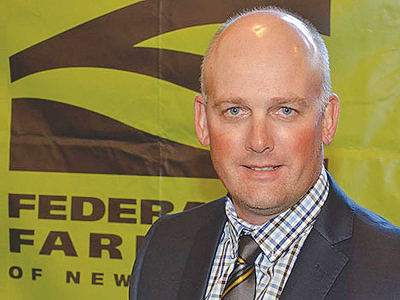 Chris Lewis.
Fonterra's farmgate milk price forecast upgrade was a welcome surprise although indicators were heading that way, says Federated Farmers dairy chair Chris Lewis.
“We are so nervous and cautious at the moment so I guess it was a bit of a surprise,” he told Dairy News.
Farmers had some expectations as they had noted the drop in the US dollar and compared to last year the GDT is on average $300/t higher.
Fonterra last week increased its 2019-2020 forecast farmgate milk price range from $6.25- $7.25/kgMS to $6.55- $7.55/kgMS.
The advance rate Fonterra pays its farmer owners will be set off the mid-point -- $7.05/kgMS -- of the revised range.
News of the upgrade would be greeted with a “huge sigh of relief” by cash-strapped farmers, says Lewis.
“It is good news for farmers who have been feeling a lot of pressure of late,” he said.
“Finance has been very tight and some of the regulations -- greenhouse gas and water -- are weighing heavily on farmers’ minds.
“There has been huge mental pressure for farmers of late, and we are overdue for some good news, so it’s a positive indicator as to where our season might end.”
He says he could feel a collective sigh of relief.
Lewis and some economists expect the current month -- when production typically hits its season peak -- could show a slight decline.
Rabobank dairy analyst Emma Higgins says they anticipate a farmgate milk price of $7.15/kgMS is possible for the 2019-20 season.
“We see global milk supply and demand remaining largely in balance over the remainder of the season,” she said.
“Coupled with a weaker kiwi dollar relative to last year, we see the possibility for further upside to our existing forecast. For now we are comfortable with $7.15/kgMS and we will be reviewing our forecast in early December 2019.
BNZ senior economist Doug Steel says the new forecast range with a mid-point of $7.05 makes sense. BNZ lifted its own forecast a few days prior to the announcement to $7.10/kgMS.
“Fonterra notes good international prices for the season to date and encouraging supply and demand dynamics for the period ahead,” Steel said.
“This suggests Fonterra has a degree of comfort that international prices will generally maintain their current decent levels.”
A watch on the GDT auctions will show how it plays out.
Fonterra chairman John Monaghan says the co-op had been achieving good prices for its milk so far this season.
“Demand for whole milk powder (WMP) has been firm, and for the full season we’re expecting it to be above last year. Global WMP production is down year to date and expected to continue to decrease for the remainder of 2019.
“We are also continuing to sell our skim milk powder at higher prices than EU and US dairy companies in Global Dairy Trade (GDT) events.”
Fonterra chief executive Miles Hurrell says there are positive signals for the milk price.
“It is still very early in the season and a lot can change. There are a number of factors we are keeping a close eye on, which is why we’ve retained a wide forecast milk price range,” he said.
Hurrell says the strong demand for the co-op’s milk and the prices being achieved, relative to other milk producing regions, demonstrate the rationale of Fonterra’s new strategy to prioritise New Zealand milk.
“One of our four priorities is to support regional New Zealand. If you take the $7.05 mid-point of today’s revision to our forecast farmgate milk price, it’s another $450 million into regional New Zealand.”
Never been busier
Federated Farmers is the busiest Lewis has ever seen it in trying to keep on top of responses to government policies, he says.
“Water, greenhouse gases, and you’ve got the biodiversity coming up, Resource Management Act, immigration announcements, the RoVE review on Primary ITO -- I could go on,” Lewis said.
“I have been involved with Feds for 13 years and we have never, ever, ever been so busy as we are now. We are stretched beyond our capacity with all the things coming out.
“It is more than overwhelming. We don’t want to let our farmers down and to do a good job requires a massive amount of resources. It’s really making us work hard.
“You have to piece it altogether -- all the science, the economics, all the different policy things. There are so many documents. There’s a 400 page one, then another 400 page one behind it.”
The Feds have had to split into different teams to deal with different sections just so they can make some sense of it.
He says there’s the election next year and he hopes some good policies come out.
Mobile phone coverage and reliability are deteriorating in rural areas, and farming families are bearing the cost, according to a Federated Farmers survey.
Central Otago District Council (CODC) has voted against a plan to spread treated sewage sludge from Cromwell and Alexandra on farmland near Lauder, a decision Federated Farmers says reflects strong opposition from rural residents.
Federated Farmers has called on Central Otago District Council (CODC) to drop or vote down a plan to truck sludge from Alexandra and Cromwell to farmland near Lauder, warning it would compound an "outrageous" situation created by a separate council's decision weeks earlier.
Federated Farmers says new legislation replacing the Resource Management Act will cut red tape, unlock investment and help grow New Zealand's export-led economy, after the Planning Bill and Natural Environment Bill passed their third reading in Parliament yesterday.
Leading figures from the major political parties will be questioned on their primary sector policies at the Rural Issues Debate at Mystery Creek Events Centre, Hamilton, on 30 September.



Safer Farms is urging farmers to make sure everyone working on farm has safe, suitable footwear for the job.

The Government is backing work on a community-led water storage scheme that could irrigate up to 11,000 more hectares of the Poverty Bay flats, Agriculture Minister Todd McClay says.
Agri-tech company Herd-i has become a new all-region sponsor of the New Zealand Dairy Industry Awards (NZDIA), the largest nationwide celebration of excellence in the dairy sector.
Four candidates have been confirmed for two director positions on Fonterra’s board.
Returning to the family dairy farm after playing 20 years of professional rugby around the world is no easy task.
After delivering another record farmgate milk price to 100 supplying farms, independent milk processor Tatua is entering thee new financial year with a positive outlook.



OPINION: It seems Canterbury processor Synlait is still in the doldrums.
OPINION: Get offside with New Zealand First leader Winston Peters at your own peril.




