Fonterra Elections 2026: Voting Opens Tuesday 20 October
Fonterra shareholders can begin voting on Tuesday 20 October in the 2026 Board of Directors’ election, a Co-operative Council election in one Ward, and seven Annual Meeting resolutions.




 increase font size
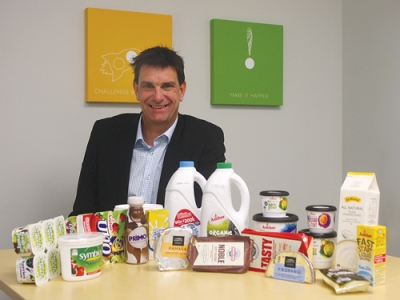 Fonterra Brands New Zealand managing director Tim Deane.
Fonterra says it is hitting the sweet spot with a spate of new products in its New Zealand brands business.
Two products – Anchor Uno yoghurt for kids and Anchor Greek yoghurt – were launched over the past eight months to a fantastic response from consumers, according to Fonterra Brands New Zealand managing director Tim Deane.
Deane says Fonterra Brands now dominates the kids’ yoghurt market; its high-protein low-fat Greek yoghurt is also popular. “There is a high demand for our yoghurts and we have hit a sweet spot,” Deane told Dairy News.
Also, the nationwide launch of Anchor organic milk this month enables the co-op to put the product within the reach of every consumer.
Deane says that with other organic milk brands only available in certain regions or very expensive, Anchor is on a mission to make organic milk more widely available at a fair price, though its product costs slightly more than conventional milk.
“We want to put organic milk in reach of more New Zealanders… through our nationwide distribution and [pricing] Anchor Organic… at only about 20 cents extra per glass compared to our standard Anchor milk.
“All dairy farming is challenging, hard work. However, organic farming costs more so we have to pay more for the milk. We also have the added complexity of keeping the milk separate during collection and bottling. So a lot of effort on and off the farm goes into creating a certified organic product.”
Organic milk consumption in New Zealand is far behind other countries; only 2.5% of the total milk we consume is organic, versus 8% in the UK and 15% in the US.
Deane says for 18 months demand has grown for organic milk, “so we decided to provide organic milk throughout the country at a fair price.”
He says 72% of Kiwis tell Fonterra that if organic milk was more affordable they would buy it more often. A further 25% say if it was available in their regular supermarket that would also make a difference.
“The total organic food and beverage market is now worth $133 million and the amount of organic milk sold domestically over the past year has increased by 50%.”
Anchor Organic milk drinkers will be able to trace their milk from the fridge back to the farms it comes from.
“Our organic milk is sourced from Fonterra organic farmers in Manawatu. We can pinpoint the farms where our organic milk comes from and follow it from the farm right through to the supermarket shelf…. That’s a point of difference between us and some organic brands that use third parties to bottle their milk,” says Deane.
Mark Flipp, a Manawatu Fonterra farmer supplying milk for Anchor Organic, says he’s excited to see his milk sold under the Anchor brand. His family farm was certified organic in 2010.
“People talk about when we converted our farm to an organic operation. However, for us getting certified was more about continuing to farm the way our family always had.
“Being an organic farmer is about seeing our farm as the land within our fenceline and rather than bringing in supplies from elsewhere we produce everything we need within that fenceline. In other words we’re self-sufficient.”
Anchor Organic milk is marketed carrying Blue or Green labels in recyclable lightproof bottles.
Fonterra shareholders can begin voting on Tuesday 20 October in the 2026 Board of Directors’ election, a Co-operative Council election in one Ward, and seven Annual Meeting resolutions.

Fonterra Co-operative Group chief financial officer Andrew Murray has resigned to take up a role outside the dairy giant.
Four candidates have been confirmed for two director positions on Fonterra’s board.
A record farmgate milk price and strong global demand is laying the foundation for continued growth of organic dairy farming in New Zealand.
Waikato milk processor Tatua has again declared a record milk payout to farmer shareholders, leaving other processors in the dust.


Farmers are being encouraged to rethink how they manage waste on farm with the launch of ruralwastesorted.co.nz, a new website bringing together practical tips, real farmer experiences and resources.

New Zealand Winegrowers (NZW) is celebrating the India-New Zealand Free Trade Agreement (FTA) coming into force today, bringing New Zealand wine improved access to one of the world’s fastest-growing economies.
New Zealand’s red meat sector has welcomed the India-New Zealand Free Trade Agreement taking effect, which removes India’s 33% tariff on New Zealand sheepmeat.
More than 95 per cent of New Zealand’s forestry and wood exports to India can now enter tariff free as the New Zealand-India Free Trade Agreement comes into force today.
Federated Farmers is backing Feilding High School’s call to keep Agriculture and Horticultural Science as a standalone subject in Year 11.
Food and fibre exports have returned a billion- dollar bonus to the country.


OPINION: It seems Canterbury processor Synlait is still in the doldrums.
OPINION: Get offside with New Zealand First leader Winston Peters at your own peril.




