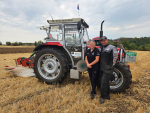
NZ Ploughing Team to Use Borrowed Gear After Shipping Mix-Up
The New Zealand ploughing team to the world championship in Croatia next month will be banking on borrowed equipment as they seek glory.




 increase font size
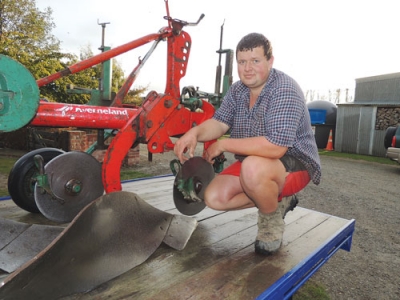 While it’s Adam Mehrtens’ first National Championships, the plough he’s using has form from way back.
Twenty year old Adam Mehrtens will the youngest competitor at the 2015 National Ploughing Championship, but the plough he’ll be using has seen action at the highest level.
“It’s won the nationals and I think Bob said he’s even taken it to a world championship,” he told Rural News.
The reference to “Bob” is to his uncle, Bob Mehrtens, several times New Zealand champion with a conventional plough who has also won the nationals and competed on the world stage with a reversible.
Adam says “hanging around” with his uncle at ploughing matches when he was a kid was what got him into ploughing. “I started when I was about 12.”
Last year he set his sights on qualifying for the nationals and this year made it “after quite a few matches” with a win at Waimate.
He says he “hopes to do pretty well” at the nationals at Palmerston but is well aware of the level of competition he’ll face.
Pulling the trusty Kverneland will be a two-wheel drive Fiat 540 with ballasted back wheels and a new coat of paint “especially for the occasion.” When Rural News caught up with him a couple of weeks ago it just needed the seat re-fitting before hooking up to the plough and getting in some practice.
As for the plough, for all its history he says it is a “pretty standard” Kverneland match plough with steel mouldboards. “I’ll probably go to plastic mouldboards eventually; they reckon the dirt doesn’t stick to them like it can to steel.”
Fellow finalist Eric Gin from Oamaru also has plastic mouldboards on his wish list but even after “six or seven” previous appearances at the nationals, he says he’s still trying to master the art with steel. “Once I get up to the next level I’ll probably progress onto plastic.”
Gin qualified at Lincoln and is hoping he can go better than his previous bests at the nationals which was second on grass, also at Lincoln, in 2013, and fifth overall.
“You try to do a better job each time but there are a lot of variables that come in. You always think you’ll get it right next time but then there’s something else: the soil conditions, or you forget to do something. Once you’ve made a mistake there’s no going back. If it’s crooked [the judges] see that.”
It’s the challenge of perfect ploughing despite the variables that makes the sport so appealing, he says. “And I like meeting the other ploughmen and the camaraderie of the people involved.”
Mehrtens echoes Gin’s comments. “You can always do better. There’s always something to learn. It’s never ending really.”
Australian experience
Gin is one of about a dozen New Zealand ploughmen who have honed their skills during a long-running exchange trip to Australia courtesy of the NZ Ploughing Association.
“Every second year we send someone over to Australia and they plough at four or five matches,” explains NZ Ploughing Association executive officer Noel Sheat.
The association pays the airfare then the ploughmen are billeted with fellow enthusiasts across the ditch for ten days to a fortnight, using a tractor and plough supplied locally to compete.
“They’re always harder to beat after they’ve been,” notes Sheat. “They’re just that bit more knowledgeable. It’s the same with the World Championships. Every time you go you come back that little bit more knowledgeable.”
Ploughmen for the exchange are selected from the National Championship line-up. To be eligible they must not have been on the exchange before or finish above fifth.
The New Zealand ploughing team to the world championship in Croatia next month will be banking on borrowed equipment as they seek glory.
Ploughing champions Mark Dillon and Malcolm Taylor earned the right to represent the country at the World Ploughing Championships in Osijek, Croatia, on 5 and 6 September, after winning their titles at the New Zealand Ploughing Championships in Middlemarch in 2025.
Sean Leslie and Casey Tilson from Middlemarch, with horses Beau and Dough, took out the Rural News Horse Plough award at the Power Farming NZ Ploughing Championships at Horotiu, near Hamilton, on April 13-14.
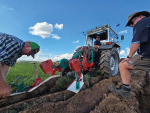
The mood is relaxed as father and son ploughmen Paul and Derek Houghton get some practice in, but when the national championship starts this Saturday it will be a different story.
With our own National Fieldays only few weeks away, Rural News took the opportunity to take a trip overseas – as a guest of Enterprise Ireland, which invited 190 guests from 19 countries – to look at Ireland’s own national event, locally known as The Ploughing.


In Dacre, near Invercargill in New Zealand’s South Island, Bruce Dinnington is running a dairy operation unlike any other.

A free online platform aggregating governance vacancies across rural and regional New Zealand has been launched.
Environment Minister Nicola Grigg has announced details of a new rural plastics recycling scheme.
Agricultural drone operators say that a government decision to allow lower-risk drone work without certification won’t lower standards but drive innovation and efficiency.
OPINION: Warning bells are ringing in the arable sector.
Farmgate lamb prices are down by 8%, beef cattle by 4.5% and farm expenditure up by 4.2%.


OPINION: It seems Canterbury processor Synlait is still in the doldrums.
OPINION: Get offside with New Zealand First leader Winston Peters at your own peril.




