While most New Zealand farmers operate with animals at pasture all year round, unlike their European counterparts, several operations in the South Island have invested in cow barns to beat the often-inclement weather.
Whilst there are many benefits in terms of increased production and animal health, a key part of the equation is presenting animals with constant access to high quality forage blends.
In practice, cattle will eat material directly in front of them, nudging material forwards until they cannot reach everything on offer. This means that feed must be manually pushed back closer, using a tractor or loader device, often many times during the day.
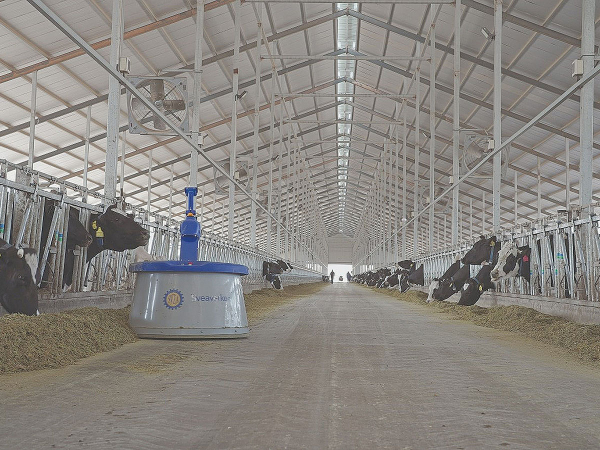
Swedish company Sveaverken helps remove this labour-intensive and time-consuming task, leaving it to be done automatically by a robot.
Equipped with numerous ultrasonic sensors to help guide itself within the barn, the artificial intelligence-powered RoboPusher Nimbo pushes the feed without human intervention.
The feed pusher uses cameras as ‘eyes’, identifying different barn environments, and continuously adjusts its path based on the obstacles in its way, alongside the cattle’s feed requirements.
“If there’s not enough feed available to the cows, the Nimbo will push it closer towards them, and if there’s too much feed, it will move some of it further away from the fence,” says company representative Felix Tian. “This ability to adjust to different situations eliminates any manual work.”
Featuring a 1.08m wide body, the feed pusher’s compact design takes up less space in the feeding bays and allows the robot to fit in a small charging station.
Equipped with numerous ultrasonic sensors to help guide itself in a barn, the battery powered robot is smart enough to return to its charging station after its feed pushing is completed. This ensures that it is always at an optimal charge level for future operation.
A mobile app also comes with innovative technology, allowing customers to set feed pushing schedules exactly to their liking. Customers can use this to receive live barn images, monitor the Nimbo’s performance and check on the herd at any time.
With some customers using Nimbo to feed push up to 20 times a day, the company says the more the feed is pushed, the more the animals increase dry matter intake, leading to better milk production.
One customer that is already reaping the benefits of the technology is Achim Behrens, who works alongside his parents at their property on the border of the Netherlands and Germany. With a herd of approximately 220 cows, Behrens decided to invest in Sveaverken’s RoboPusher Nimbo due to its automative benefits.
Originally facing the challenges of manually pushing feed for the cattle, particularly late in the night, Behrens says the innovative solution has proved to be a game changer.
“Thanks to the feed pushing robot, we no longer have to manually push feed in the evening. The robot automatically pushes feed up at night, so saves us at least one to one and a half hours of work every day.”
Visit www.sveaverken.com for more.