Carrying people to inaccessible parts of a property has always been a challenge, but it must be done safely and by the rules.
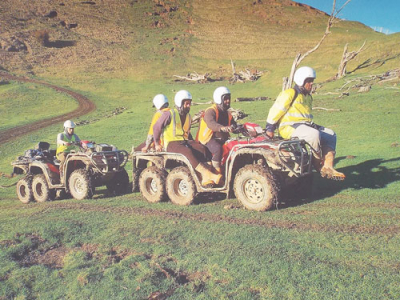
National Fieldays’ understanding of safety was seen lacking in its Innovations exhibit by Blinkhorne and Carroll, Wanganui, of a modified Honda quad said to be “certified to carry seven passengers”.
Quad makers are careful to urge ‘one rider only’ -- in safety stickers and in the first pages operator manuals.
So your reviewer wonders at the modifications made to enable the Blinkhorne and Carroll machine to carry eight people or a ‘certified’ payload of 800kg.
The main modification was a third axle added to the rear of the machine; this might explain the increased load capacity. But fitting seven sets of rubber hand-grips can’t make the machine ‘certified’ to carry seven passengers. The engineering appeared well done, but it beggars belief that the business would court disaster by saying it is safe to carry so many extra passengers on the machine’s original load racks, even if only on level ground.
The company also said riders need only wear protective headgear at speeds over 30km/h.
Patrick Carroll, for the exhibitor, described to Dairy News how the machine – one of three – is used to take staff into remote central North Island country for forest maintenance.
He said the driver has the say on passenger numbers should the machine start to feel unstable.
But Carroll is missing the point about safety because if “the machine feels unstable or the terrain changes” then the driver has not done a thorough pre-ride assessment.
Likewise, the company’s statement that on a slope the top-side riders should “step off” in the event of instability shows it doesn’t understand how these machines should be operated, given that such action could cause the machine to tip more quickly.
This shows up in its YouTube video of a rider climbing a near-vertical terrace without shifting his bodyweight forward, and the traverse of a narrow track with a steep drop-off while passengers sit casually on the machine’s racks.
Both scenarios show an accident waiting to happen, given that quads require ‘active riding’ and the operator has no control over the shifting body-mass of his passengers.
Entry criteria for the Fieldays Innovation Awards show a built-in weakness in the acceptance of this entry that ignores best practice as advised by the machine’s manufacturer and by Worksafe.
Fieldays said it had received a mechanical engineer’s report on the machine’s suitability to carry seven passengers, but as Dairy News went to press it had not named the engineer