
Pouarua Water Storage Scheme Gets Government Backing
The Government is backing work on a community-led water storage scheme that could irrigate up to 11,000 more hectares of the Poverty Bay flats, Agriculture Minister Todd McClay says.




 increase font size
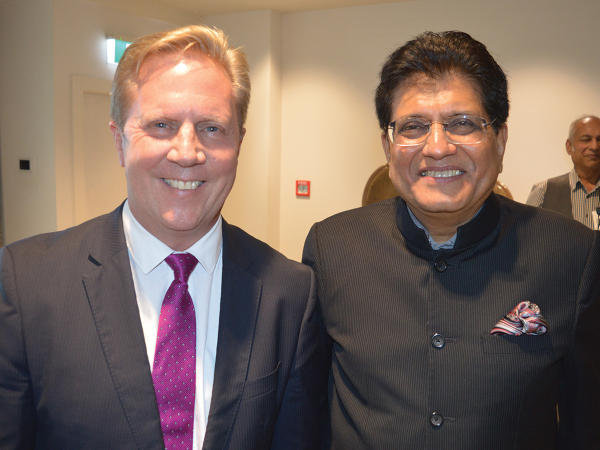 Trade Minister Todd McClay with Indian Commerce Minister Piyush Goyal in Auckland last week.
The dairy sector is hopeful of being part of a free trade deal being hammered out between New Zealand and India.
Dairy Companies Association of NZ chair Guy Roper told Dairy News that the joint commitment from the Prime Ministers of India and NZ in April was for a balances, ambitious, comprehensive and mutually beneficial trade agreement.
"We understand that comprehensive means covering the terms of importance to both sides, and, therefore, expect dairy to be part of an FTA," says Roper.
"We also understand the sensitivity of dairy within the negotiation - this has been well signalled from the outset - but we also believe there is significant scope for a closer trading relationship in dairy that benefits both countries."
Last week, India's Minister for Commerce and Industry Piyush Goyal was in the country for a fifth round of negotiations between the two countries. He also attended a NZ/Indian Business Summit with Trade Minister Todd McClay, Roper, an Indian trade delegation and local business leaders.
Asked if dairy would be part of an FTA between the two countries, Goyal replied that "we'll let you know in due course once we have finalised the entire agreement".
"The agreement must be seen in its entirety: it cannot be seen in just small parts. And what we'll have to look at the opportunities it unfolds for both countries," says Goyal.
"And in that context, we will give you all the details once it's finalised."
Goyal talked about "sensitivities" around the potential FTA.
The Indian dairy sector provides livelihoods to 80 million people and opening the sector to New Zealand imports wouldn't go down well with Indian farmers.
Goyal points out that India and NZ are "two very different sized economies".
"India is 1.4 billion people market. It's the fastest growing large economy in the world for several years now and and expected to continue to be the fastest growing economy for possibly a couple of decades in the future.
"We add more to the GDP every year than the entire New Zealand economy.
"So, in all this context, you have to see what is the balance that we can create in this agreement. And therefore, both sides are cognisent of the opportunities and of the sensitivities."
India is the world's largest milk producer, accounting for 24% of global milk production. It does, however, import a small amount of dairy products, buying $50m worth of products from NZ, making up 13% of total Indian imports.
Analysts believe India won't open its market for NZ dairy products. However, collaboration between the Indian and NZ dairy sectors is something the Indians could live with.
Indian public policy and business expert Ashok Malik told an India/NZ Business Summit earlier this year that with a population of 1.4 billion, India shouldn't be seen just as a market for products but for partnerships.
Roper says New Zealand's dairy exporting model is primarily about matching what it makes - world-class dairy ingredients - with the needs of food manufacturers and food service providers in other countries.
"At the heart of that trade is a value-chain partnership between New Zealand suppliers and their end-use customers, for either domestic consumption or for export to third markets.
"This model spurs economic activity and grows prosperity for both countries."
The Government is backing work on a community-led water storage scheme that could irrigate up to 11,000 more hectares of the Poverty Bay flats, Agriculture Minister Todd McClay says.

A seasoned horticulturist has been appointed to deliver the Apple Action Plan, a key initiative of the India-New Zealand Free Trade Agreement.
A Labour-led Government won’t be bringing back the controversial freshwater rules of 2020.
National’s much-touted free trade deal with India featured in the Rural Issues Debate at Mystery Creek, Hamilton on Wednesday night.
It was billed as a chance for all the political parties to woo the rural vote, but question marks hang over just how effective this was.


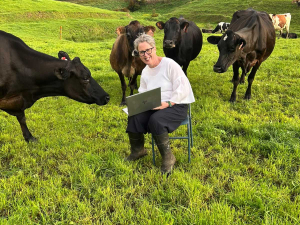
Today, 15 October, is the International Day of Rural Women, which recognises rural women’s contribution to farming, communities and the environment.

Global dairy giant Lactalis has integrated its Australian operations with the Mainland Dairy consumer business it acquired from Fonterra earlier this year.
After almost two decades of sharemilking, saving and building equity, Aaron and Marcia Flay this year realised their long-held dream of settling on their first dairy farm.
Good medium to long term prospects for NZ beef, especially in the US, has heighted the focus on various initiatives to capitalise on this situation.
High country stations, mixed sheep and beef farms, Māori-owned farms, corporates and family operations are among the nine commercial farms taking part in the Livestock Innovation Farming Transformation programme, known as LIFT.
OPINION: New health and safety guidance unveiled by the Government recently provides farmers greater certainty about what is expected of them when managing risks on farm.



OPINION: It seems Canterbury processor Synlait is still in the doldrums.
OPINION: Get offside with New Zealand First leader Winston Peters at your own peril.




