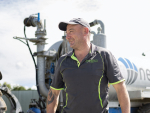
Boosting Crop Production by Spreading Effluent
Tararua district farmer Jamie Harris milks around 400 cows using a split calving system on his farm, Crossdale Dairies.




 increase font size
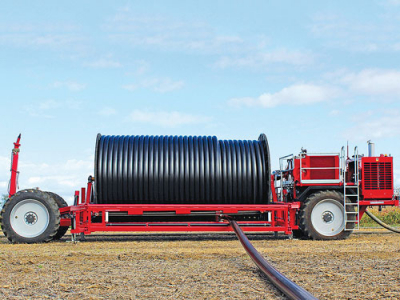 Cadman's Continuous Manure Applicator.
While New Zealand plays catch-up and Europe leads in using farm effluent, it was always going to fall to the North American continent to go large — very large.
At the recent Euro Tier 18 event in Hanover, Germany, the Canadian company Cadman showed off its self-propelled slurry pump and reeler system called the Continuous Manure Applicator (CMA).
Offered in three versions, all powered by a DPS (John Deere), 9.0L, 375hp engine, the CMA 5500 carries a whopping 853m of 139mm diameter delivery hose.
The applicator unit, carried by a tractor in the paddock, has a swivelling connector arm to keep the supply hose in the same position when the tractor makes a headland turn to begin a return run.
The CMA is synched to the spreading tractor by GPS, with the system paying out or re-winding the delivery hose at the same rate as the tractor’s travel speed.
At the headland, when the tractor makes a turn to set up for the next run, the CMS automatically moves forward to keep the hose in alignment for a straight pull.
The unit is said to achieve outputs of up to 200 cubic metres depending on material consistency and ground topography. The manufacturer says the key benefit of the system is its use in row-crops such as maize — even crops 1m tall — with no physical damage to the plants.
The machines are designed to be moved between jobs by a tractor about 350hp.
Tararua district farmer Jamie Harris milks around 400 cows using a split calving system on his farm, Crossdale Dairies.
Water management is an integral component of sustainable farming practices, according to Watermetrics.
Two farmers and two farming companies were recently convicted and fined a total of $108,000 for environmental offending.
A Taupiri farming company has been convicted and fined $52,500 in the Hamilton District Court for the unlawful discharge of dairy effluent into the environment.
Founded in Germany as recently as 1977, today, the Fliegl Group employs more than 1100 workers, offering an expansive range of transport solutions, from their base in Bavaria.


Dairy processors are ready to further boost New Zealand’s export earnings but want the incoming government to match their ambition with good policy.
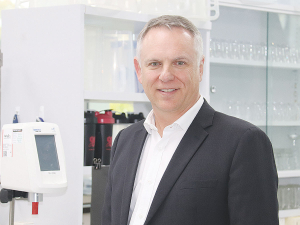
Massey University is best placed to solve the “problems” facing the dairy industry, says vice chancellor, Pierre Venter.
Synlait's longest serving employee – a man who joined the Canterbury-based milk processor even before it began processing milk – is now its newest executive.
A dairy industry leader believes eradicating the common and costly disease, Bovine Viral Diarrhoea (BVD) is within reach.
A farmgate milk price of $10/kgMS this season is firming up as milk powder prices soar and the New Zealand dollar weakens.
Federated Farmers has welcomed new rural policies released by ACT, saying they align closely with its own election priorities.

OPINION: It seems Canterbury processor Synlait is still in the doldrums.
OPINION: Get offside with New Zealand First leader Winston Peters at your own peril.




