Kuhn Group Sales Dip 9% in 2025 but Orders Signal Recovery
Kuhn Group recorded net sales of NZ$2.27 billion in 2025, finishing around 9% lower than in 2024.




 increase font size
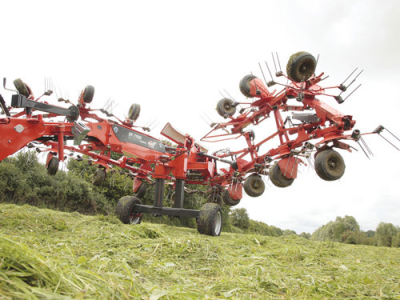 Super sized gyrotedder.
Kuhn has upgraded its range of high capacity tedders with a new chassis design and rotor lifting mechanism which allows higher ground clearance and improved contour following on undulating terrain.
The GF 13012 and GF 17012 Gyrotedders have the capacity to ted up to 15ha/hour, the former using 12 rotors across 13m operating width, and the latter using 16 rotors to cover 17.2m.
Improved headland clearance: the outer sections are supported and held in position by self-reeling tension straps that allow all the rotors to lift in one motion.
The set-up, something like the seatbelt layout in a car, is claimed to reduce stress on the main chassis and individual rotor sections, and keep the machine stable across its entire width on rough ground.
The supporting straps also act as safety guards, replacing traditional steel items, saving weight and eliminating breakages caused by vibration or metal fatigue. Rotors are raised hydraulically on the headland by a pair of transport wheels, to provide high clearance which offers the ability to cross windrows without dragging up heaps or clumps.
Terrain following is affected by the Kuhn Ground Save Control (GSC), where the rotor train is allowed to travel independently of the chassis, eliminating excessive ground contact, contamination and tine wear.
Rotor height is controlled by a single screw adjuster positioned next to the 3-point linkage.
Despite their huge operating widths, both machines fold compactly for transport, the GF13012 measuring 2.4m wide x 6.5m long x 2.68m high, and the GF17012 measuring 2.4m x 7.5m x 2.68m.
Weight is 2800 and 3400kg respectively; power requirement is 80-100hp.
Kuhn Group recorded net sales of NZ$2.27 billion in 2025, finishing around 9% lower than in 2024.
ZED, the dedicated wholesale division of CB Norwood Distributors, and the importer and distributor for Kuhn in New Zealand, has announced investment in local expertise and stock availability for customers in 2026.
Kuhn has announced an expansion of its range of disc mowers, distributed by Norwood in New Zealand, with the addition of two new vertically folding rear mounted models, the GMD 3515 and GMD 4015.
With most forage harvester manufacturers offering machines touching 1000hp, the logistics puzzle has always been ‘dropping” grass and pulling into a swath big enough to feed the “beast”.
French company KUHN has won a EIMA Technical Innovation Award for its Baler Automation Technology.


National’s pledge to introduce 19 new national standards shows the party is serious about getting Wellington out of farming, Federated Farmers says.
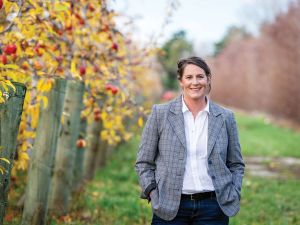
The National Party’s policies to make it easier to grow fresh vegetables, secure reliable water and energy and simplify farm planning are practical changes that will give growers the confidence to invest, according to Horticulture New Zealand (HortNZ).
Fonterra Co-operative Group chief financial officer Andrew Murray has resigned to take up a role outside the dairy giant.
A major move is about to get underway to improve the quality and viability of dairy beef and cattle in NZ.
Veterinarians say changes to the code of welfare for dairy cattle provides a positive foundation for improved cattle welfare across the country.
Today, 15 October, is the International Day of Rural Women, which recognises rural women’s contribution to farming, communities and the environment.


OPINION: It seems Canterbury processor Synlait is still in the doldrums.
OPINION: Get offside with New Zealand First leader Winston Peters at your own peril.




