
Fencing smarts from the Emerald Isle
While a leading New Zealand brand seems to have a stranglehold on the local electric fencing market, a company from the Green Isle seems to be making significant inroads, particularly in the Northern Hemisphere.




 increase font size
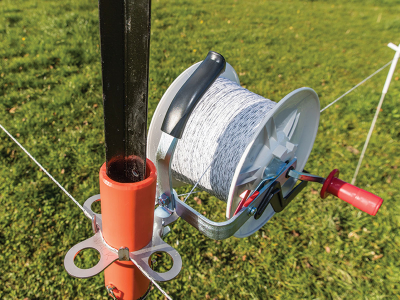 Wacky Y post.
Four years after he quit farming, Tim Deans, an engineering-savvy guy, has emerged from his Rangiora workshop with a new electric fence add-on.
His creativity was spurred by poor fencing on his property.
A need for temporary fencing and gates prompted a design that uses existing hot wires and pig-tail standards, but adds an element of greater security and versatility in awkward shaped areas.
Hence his patented Wack Y Post, with a central insulated sleeve that slides over then pins to conventional Y-section steel posts.
This in turn carries a stainless steel plate with wire guides and hook points for reels and gate fasteners. The layout of the plate allows ‘hot’ wires to be run in any direction and if required be run 360 degrees without intersecting.
The insulators are made of recycled plastic and the carrier plate is made from 304 grade stainless steel.
Deans says using the Wack Y posts for temporary fencing can increase overall strength and security. He says Y-posts driven to about 400mm gives a fence line more stability than a run of pigtail standards.
“This means that using the Wack Y Post system for key locations or direction changes, with pigtails for the straight runs, makes for a very secure fence,” he said.
The posts have been tested holding dairy heifers, horses and ponies and “always maintained their integrity”.
The fitment also allows units to be ‘stacked’ one on another to create a multi-strand fence if required, limited only by the length of Y-post.
Orange insulators make the fence easy to see in long grass and gateways.
The four guideposts and ring connector on each assembly make direction changes easy, eg around awkwardly shaped areas such as paddock corners or ponds or watercourses.
Used for feed breaks, Wack Y Posts can be run in lengths with intermediate breaks or to suit smaller mobs.
While a leading New Zealand brand seems to have a stranglehold on the local electric fencing market, a company from the Green Isle seems to be making significant inroads, particularly in the Northern Hemisphere.
Police in the Waitematā North district are urging landowners to ensure their fences are secure after several complaints about wandering stock.
GreenRiggers electric fence outriggers are designed and manufactured in New Zealand.
Taragate's updated geared reel system is an even more user-friendly unit.
A new energiser from Datamars Speedrite range claims to be the first “smart” electric fence unit, alongside an output of 46 joules.



National’s pledge to introduce 19 new national standards shows the party is serious about getting Wellington out of farming, Federated Farmers says.

The National Party’s policies to make it easier to grow fresh vegetables, secure reliable water and energy and simplify farm planning are practical changes that will give growers the confidence to invest, according to Horticulture New Zealand (HortNZ).
Fonterra Co-operative Group chief financial officer Andrew Murray has resigned to take up a role outside the dairy giant.
A major move is about to get underway to improve the quality and viability of dairy beef and cattle in NZ.
Veterinarians say changes to the code of welfare for dairy cattle provides a positive foundation for improved cattle welfare across the country.
Today, 15 October, is the International Day of Rural Women, which recognises rural women’s contribution to farming, communities and the environment.



OPINION: It seems Canterbury processor Synlait is still in the doldrums.
OPINION: Get offside with New Zealand First leader Winston Peters at your own peril.




