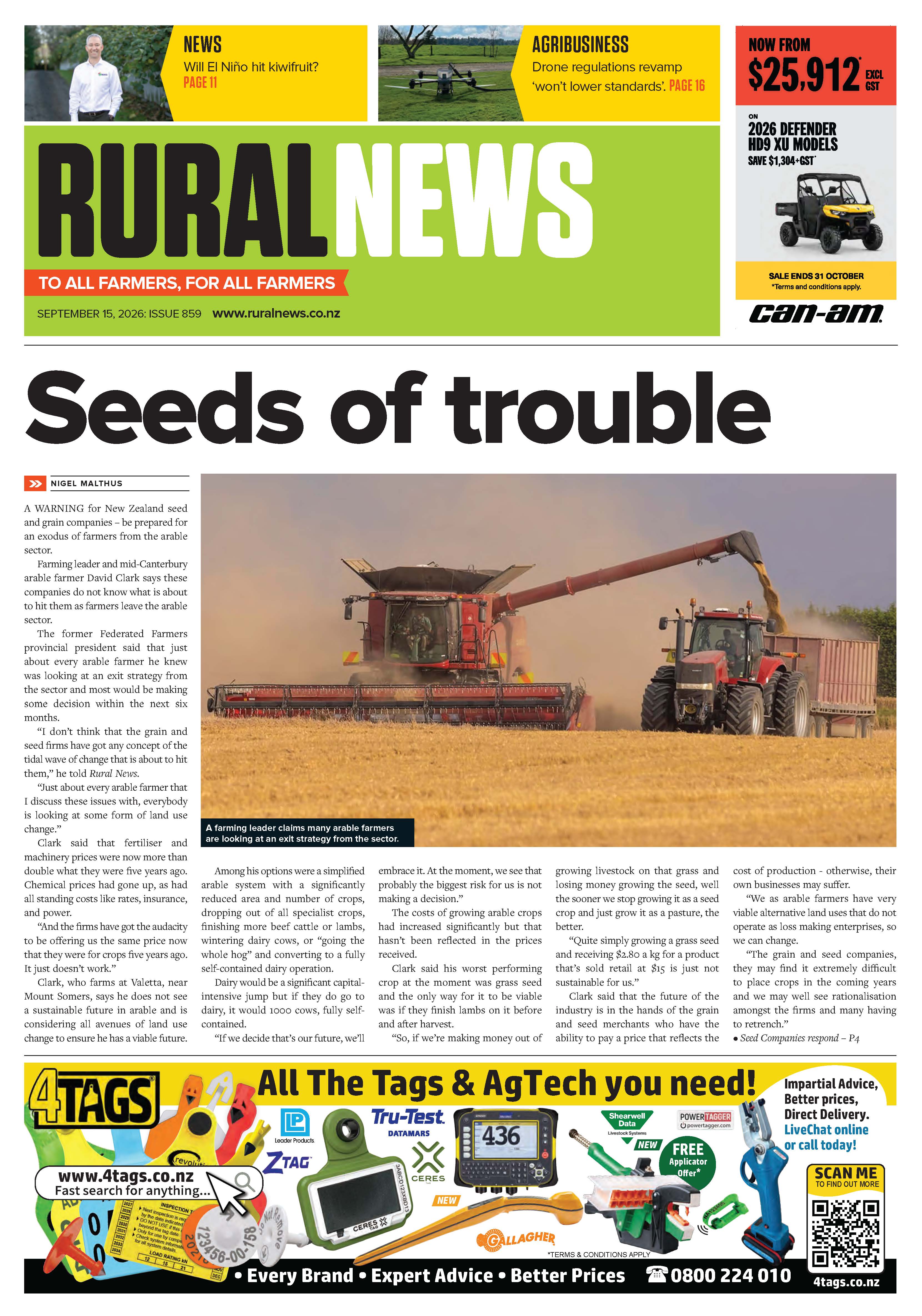
Fall Armyworm in NZ Maize: Four Years of Research
Four years since it was first detected in New Zealand, researchers and growers now know much more about management of maize pest fall armyworm (FAW).




 increase font size
 Ian Williams
Many farmers are now facing hefty onfarm challenges. While the low milksolids payout is influencing cashflow and profitability, dry conditions are starting to limit pasture growth and milk flows in many key dairy regions.
There is no ideal ‘recipe’ for this autumn, but consider the following key management principles.
Feed out grass silage and summer crops first
After a reasonable spring, most farmers still have good quantities of supplementary feed on hand. Feeding silage and summer crops now not only keeps cows in milk but also protects pasture cover; this is increasingly important to ensure the persistence of modern pasture species. If you are feeding silage, always ensure you have at least 100kgDM/cow on hand to feed when it does rain.
Reduce demand onfarm by selling genuine culls
Most farms have about 10% genuine culls which will leave the farm before winter. These need to go now. For a 400-cow farm, culling 40 cows will release about 600kgDM – an extra 1.7kgDM – for every cow remaining.
This feed can be used to increase intakes and, hopefully, milk production.
With the meat schedule remaining high, culls are returning good prices at the works.
Protect pasture covers by feeding silages vs concentrates
Many pasture scientists acknowledge that summer over-grazing can reduce the productive life of pasture to the same degree as winter pugging. Ensuring pasture isn’t over-grazed protects the plant itself and keeps the plant in a better state to respond quickly to moisture once the rains come.
Cows eating silages (e.g. grass and maize silage) or summer forage crops (e.g. brassicas or forage sorghum) tend to leave behind more pasture than those eating concentrates (e.g. PKE, meal, and grain). Feeding grass silage and maize silage on a feed pad, standoff pad or sacrifice area enables farmers to drastically reduce the pressure on pastures, protecting cover levels and reducing pasture damage.
Keep cows in milk
Even in a low payout year, drying off milking cows too early doesn’t make sense (Table 1).Table 1 shows that even at a $4.50/kgMS payout, with cows producing as little as 0.7kgMS/cow/day, feeding maize silage (35c/kgDM eaten, 10.8 MJME/kgDM) generates a return of about $1.00/cow/day.
For a 400-cow herd it is worth about $400/day to keep cows in milk.
Watch body condition score (BCS)
Achieving BCS targets of 5.5 for your first and second calvers and 5.0 for the rest of the cows in the herd is highly profitable even at a $4.50/kgMS payout.
There is no better farm system feed than maize silage to enable you to do this because it will keep cows in milk while protecting body condition and pasture cover levels.
Careful and strategic management will ensure you make the most of a challenging autumn.

Tel. 0800 746 633
• Ian Williams is a Pioneer forage specialist. This email address is being protected from spambots. You need JavaScript enabled to view it.
Four years since it was first detected in New Zealand, researchers and growers now know much more about management of maize pest fall armyworm (FAW).
As spring calving cows head into dry-off, the priority shifts to one thing: setting cows up to calve at the target body condition score (BCS).
Early December marks a key transition for many dairy farmers, as weaned replacement heifers head off-farm to grazing.
I recently had the pleasure of attending an AgFirst event in Hamilton where the results of the 2024-25 Waikato-Bay of Plenty Dairy Financial Survey were shared. Based on a 136ha farm milking 379 cows, average farm profit before tax was $405,892, an incredible 286% increase on the 23-24 season.
Over the past few months, I’ve had the privilege of speaking with many farmers at events and one-on-one.



LIC shareholders have elected a new North Island representative to the co-operative's Board, along with five representatives to its Shareholder Reference Group (SRG), following the company's Annual Meeting held in Invercargill.
Farmers across parts of Southland and South Otago are continuing to deal with difficult conditions after a prolonged run of wet weather, with pressure building around feed supply, stock management, pasture damage, farm infrastructure and everyday workloads.
Federated Farmers says it welcomes Labour's commitment to reviewing the Sharemilking Agreements Act, calling on other major parties to do the same.
For Canterbury dairy farmers Sian Meijer and Rick Wobben, wearable technology has become one of their most valuable on-farm tools - helping manage 1850 cows across an expansive, high-performing dairy operation while improving efficiency, mating outcomes and day-to-day decision making.
Fonterra has unveiled its annual results for the 2026 financial year, posting $27 billion in revenue and close to $20 billion returned to New Zealand farmer owners and unit holders.
The first major update to the Dairy Cattle Code of Welfare in more than a decade has been released, marking what DairyNZ describes as an important step in ensuring animal welfare standards continue to evolve alongside scientific evidence and on-farm realities.

OPINION: It seems Canterbury processor Synlait is still in the doldrums.
OPINION: Get offside with New Zealand First leader Winston Peters at your own peril.