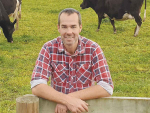
Cameron Henderson Reappointed Unopposed as DairyNZ Deputy Chair
DairyNZ deputy chair Cameron Henderson has been re-appointed unopposed for another term.




 increase font size
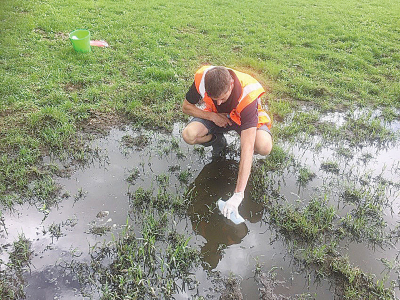 A Waikato Regional Council officer taking a sample of ponded effluent.
The dairy industry is supporting councils in their efforts to get all farmers to meet their effluent obligations.
DairyNZ and Waikato Dairy Leaders Group chair Jim van der Poel says everyone is disappointed that a few individuals continue to let the sector down by not complying with effluent management rules.
“There is no excuse for repeated [preventable] offences,” says van der Poel.
He was responding to news that a Cambridge farming company and one of its directors were each convicted of eight charges under the Resource Management Act in early March in Hamilton District Court and fined a total of $131,840.
This is the largest total fine imposed for illegal dairy effluent discharges into the environment in the Waikato region since the RMA came into force in 1991.
The company, Pollock Farms (2011) Ltd, runs a dairy farm on Victoria Road near Cambridge. One of its directors, Dawson Craig Pollock, was prosecuted for similar breaches of the RMA in 1993 and 2001.
Van der Poel says the total fine in this prosecution is significant and sends a strong message to farmers.
“We support the Waikato Regional Council and other regional councils in monitoring and prosecuting farmers for serious infringements of the rules.
“From our point of view, any breach is one too many. Managing effluent is a necessary part of running an efficient dairy system.
“The sector needs those farmers who aren’t doing the right thing with their effluent management to step up, take responsibility and make the necessary changes.”
DairyNZ supports farmers in making such changes: resources are available to help all dairy farmers -- a Dairy Effluent Storage Calculator, A Farmer’s Guide to Building a New Effluent Storage Pond and access to accredited effluent system designers.
“Most dairy farmers are doing their utmost to… protect the environment and the waterways that run on and near their farms every day,” says van der Poel.
“Significant non-compliance for dairy effluent discharges nationally in 2016-17 was 5.2%, the lowest on record, but we realise there is still a way to go.”
The dairy sector is helping farmers to operate more sustainably, overseeing huge improvements during the last decade, including fencing off 99.4% of significant waterways.
The sector strategy document Dairy Tomorrow says, firstly, ‘We will protect and nurture the environment for future generations’ “and we intend to get all our farmers on track to achieving that goal,” says van der Poel.
“Our vision is clear: we want healthy waterways, and we will help farmers achieve it, just as the vast majority of farmers are committed to doing their bit.”
DairyNZ deputy chair Cameron Henderson has been re-appointed unopposed for another term.
Farms across the upper North Island are trialling different pasture mixes as part of a research programme that aims to build greater resilience into farming systems.
Election years are always a concerning time for farmers, according to DairyNZ chair Tracy Brown.
Most dairy regions around the country have had a pretty good season so far says Tracy Brown.


Farmgate lamb prices are down by 8%, beef cattle by 4.5% and farm expenditure up by 4.2%.
Kiwifruit growers are watchful but remain optimistic as concerns around the potential effects of the El Niño weather pattern this season.
Almond hulls sourced from Australian orchards may have the potential to help New Zealand cows reduce emissions, boost milk yield and lower input costs.
Striking a balance between meeting the needs of industry to speed up approval time for products but on the other hand ensuring that risks are properly assessed.
Surprised, humbled and quite thrilled. That’s the reaction of James Allen, one of the founding partners and now chief executive of AgFirst, on being made a life member of the Institute of Rural Professionals.




OPINION: It seems Canterbury processor Synlait is still in the doldrums.
OPINION: Get offside with New Zealand First leader Winston Peters at your own peril.