Shining with big help from robots
Southern Star Farms Ltd, an 85ha mixed farm near Waituna Lagoon, Southland, runs 300 Jersey cows and 2500 breeding ewes – a farm run seamlessly by Darrin and Joanne Crack.




 increase font size
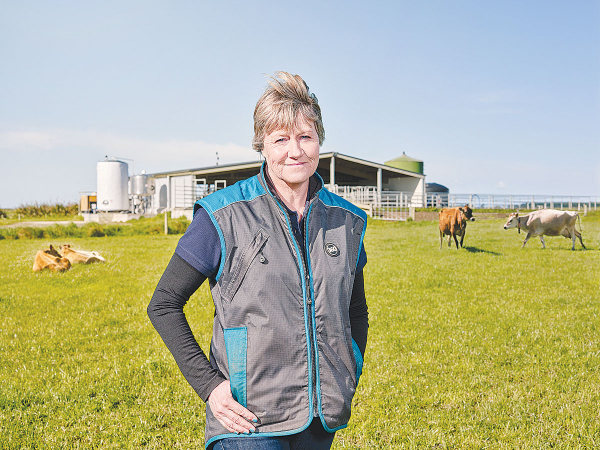 Farmer Joanne Cracks says robotic milking has given them freedom.
Southern Star Farms Ltd is a 456ha mixed farm near Waituna Lagoon, Southland, which runs 300 Jersey cows and 2500 breeding ewes.
The operation is run seamlessly by husband and wife duo Joanne and Darrin Cracks.
Joanne looks after the dairy side of the business, where cows are milked through four Lely Astronaut A4 robots, while Darrin looks after the drystock operation.
The concept of robotic milking is said to be built around the cow, ensuring cows like to be milked, making it very different from conventional milking in many ways.
One of the main differences, according to Lely, is that cows can be milked more in line with their natural behaviour. The Cracks' operation enables their cows to be milked more than twice a day whilst still being able to graze when they like, utilising a 100% pasture-based system.
Six years on from the installation of their Lely Astronaut A4 robots, Joanne says the main benefit of converting to robots was she would be able to look after 300 cows by herself, without any staffing issues.
"Fewer staff needed; for me this is one of the most attractive aspects of having a robotic system. I can look after my 300 cow by myself.
"I run our robotic dairy unit virtually on my own. I don't need every second weekend off as it's not physically demanding. I once broke a bone and wrecked the ligaments in my knee, [but] I was still able to run the robotic dairy unit, albeit much more slowly.
"I wouldn't have been able to milk in a conventional system. I do have help for calving and have someone to help with [feeding] the calves."
Discussing the upsides of their robots, Joanne says she doesn't have to strip the colostrum cows.
"Of the 300 cows we calve down each season, not one is stripped unless the robot draws attention to the cow for mastitis or high somatic cell count. Of course, if I have a cow that is not milking out in a quarter, I will put her aside and check her.
"This season I checked or stripped about five colostrum cows. I don't use teat seal."
As well as this huge time saving advantage, the cows are always milked out properly.
"This was always the biggest issue of the herringbone," she says. "Nobody wants to wait for a slow cow. Robots don't mind and they take the cups off each quarter as it is milked out. This is certainly not possible in a conventional system."
Joanne has found less mastitis in the herd, therefore has to use fewer drugs, doesn't have to change out milk lines between cows, has fewer problems with sore feet, and gets a longer herd lifespan due to the extremely gentle treatment of all cows.
"I find the heifers are able to compete with the cows in the robotic system far better than they ever did in the conventional system."
With no ambition to milk more than 400 cows through their current Astronaut platform, Joanne instead wants to improve milking times and frequency of robot visits. "I have found with robots that less is more in terms of cow numbers.
"As I am able to increase the milking speed of my cows, I should end up with more free time... and therefore room to milk more cows if I want to. We have room for improvement without increasing cow numbers."
Spending just an hour in the shed each day, plus around 20 minutes setting up the four feed breaks for the day, Joanne now has the flexibility to get her jobs done when she wants to.
"I don't have to do my jobs at the robot shed at 4am or any other regular time. If I've got plans for the day I do my jobs at a time that suits me. I'm often here at 7pm at night, but that suits me.
"It's rare for me to be at my robot shed before 9am, unless I'm going to be away for the day. There's no need for someone to be there monintoring the robots. If they need me, they ring."
Southern Star Farms Ltd, an 85ha mixed farm near Waituna Lagoon, Southland, runs 300 Jersey cows and 2500 breeding ewes – a farm run seamlessly by Darrin and Joanne Crack.


The Royal New Zealand College of General Practitioners (the College) and Hauora Taiwhenua Rural Health Network are calling for investment in a proposed new training pathway for rural GPs, warning that many rural practices are struggling to recruit while a large share of the existing workforce nears retirement.
Federated Farmers has called on Central Otago District Council (CODC) to drop or vote down a plan to truck sludge from Alexandra and Cromwell to farmland near Lauder, warning it would compound an "outrageous" situation created by a separate council's decision weeks earlier.
Synlait has swung to second-half profit as operations stabilise, but the dairy processor still posted a $75.4m annual loss.
LIC shareholders have elected a new North Island representative to the co-operative's Board, along with five representatives to its Shareholder Reference Group (SRG), following the company's Annual Meeting held in Invercargill.
Farmers across parts of Southland and South Otago are continuing to deal with difficult conditions after a prolonged run of wet weather, with pressure building around feed supply, stock management, pasture damage, farm infrastructure and everyday workloads.
Federated Farmers says it welcomes Labour's commitment to reviewing the Sharemilking Agreements Act, calling on other major parties to do the same.

OPINION: It seems Canterbury processor Synlait is still in the doldrums.
OPINION: Get offside with New Zealand First leader Winston Peters at your own peril.