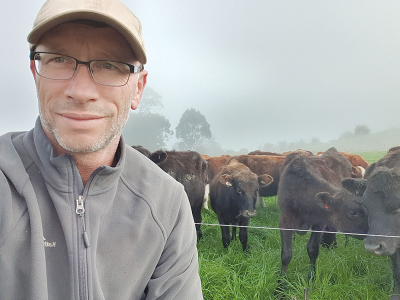
Waikato grazier James Reeves is an advocate for electronically tagged animals and keeping NAIT account up to date, says OSPRI.
OSPRI runs NAIT and TBfree in a primary industries/government agencies partnership.
Reeves grazes 120 dairy heifers at any one time for two dairy farmers, one for about 10 years. He has one NAIT-registered location and manages two properties.
“On the main farm we have a mix of R1s and R2s and rear calves. The leased grazing block is 2km away as the crow flies.”
Other animals graze a leased block belonging to the landowner. He has a separate NAIT number for his herd.
Reeves’ NAIT number is registered to the main farm.
“It’s essential you keep your herds separate at all times,” he says. “This is a NAIT requirement and supports disease management.”
Reeves uses a livestock scanner for registering winter grazing.
“In the past, we would normally receive an email from NAIT asking us to confirm that we have received animals from the farmer.
“Now, as the animals arrive on farm, we intend scanning them as they come off the truck and with the Bluetooth connection to the phone app we will be able to register a receiving movement directly into NAIT.
“And we can now scan animals going off our block and confirm a sending movement in NAIT.”
Reeves says some farmers might query the wisdom of buying a livestock reader for a small operation.
“But try reading a NAIT tag without a tag reader in a race -- it’s very difficult.
‘We probably use the tag reader three times a year for tagging and scanning. But we can also use it for weighing stock, which we do every six weeks.
“I’ve always been an advocate for RFID tags from back in the day. All stock, in my opinion, should be electronically tagged, and not just for animal health.
“Consumers nowadays are very particular about the source of the food they’re eating. So the idea of ‘farmgate to plate’ is not just a slogan to me, it is tangible and real.”
Animals reared by Reeves go direct to slaughter or the saleyard.
“We’ve locked in that the saleyard acts on our behalf for recording and confirming required livestock movements. We just have to confirm the movements when we get the email.”
NAIT re-registration essential
James Reeves says NAIT re-registration is “incredibly important”.
His advises farmers to do it online or get help to do it if they cannot do it themselves.
“Mycoplasma bovis has brought it home to the wider pastoral sector,” he says.
“When NAIT was introduced, unfortunately the regulators didn’t do enough to oversee and enforce RFID tagging.
“They’ve gone too easy on farmers. The system isn’t perfect, but if everyone had been doing their NAIT in the first place we might sooner have been able to fence off M. bovis to prevent it from spreading.”