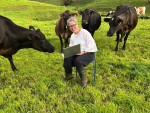
International Day of Rural Women: Two DairyNZ Farmers’ Stories
Today, 15 October, is the International Day of Rural Women, which recognises rural women’s contribution to farming, communities and the environment.




 increase font size
 John Roche, DairyNZ.
Using bought-in supplement to ‘produce milk for milk’s sake’ could be robbing the New Zealand dairy industry of its resilience says DairyNZ primary scientist John Roche.
Roche told a Smaller Milk and Supply Herd conference in Whangarei in late June that some farmers had replaced good pasture management with overuse of their checkbooks to try to get more milk out of cows for longer.
In the 2008-09 season only 15-20% of farmers said they were using supplement year-round or, at the end of the year; but that had jumped to 24-30% by 2013-2014. As a result, Roche says, NZ has gone from being one of the most economical producers to one of the more costly.
This change is likely to test farmers for at least the next 12 months, he says, as the global dairy market goes from its up cycle to its down cycle. “Only when the tide goes out do you see who’s been swimming naked.”
In 2000 European and US trade officials had emptied their warehouses of product, creating a global shortage which NZ farmers quickly took advantage of. Production increased by 20 billion litres by 2013-14 – 9b more than in 1999-2000.
Production increases have come at a cost to NZ; an International Farm Comparison Network study revealed a 300% rise in production cost between 2000 and 2012, making California a more cost-effective dairying location. This amused visiting farmers who came to see an efficient, cost-effective industry: “Farmers from all over the world still visit NZ to find out how to farm, but some now leave shaking their heads,” Roche says.
More international farmers learnt lessons from the NZ dairy industry of old, says Roche, especially after 2014 UK studies revealed the average farmer on pasture required 139 cows to generate 30,000 pounds sterling (NZ$69,0000) a year while farmers operating on a TCR system needed 413 cows.
While top performing TCR farmers managed to out-perform top system one -- three operators by a slim margin – that did not apply to average operators. “In most cases simple systems work best for most people. While farmers like to think they’re above average not every farmer is, and you must keep your eye on the ball with cashbook systems.”
Roche says the secret is farming on a resilient model which mixes good supplement use, animal husbandry, financial prudence, pasture management and smart labor use.
While day to day supplement management may be a tactical decision to plug short term feed deficits or maintain animal condition, yearly supplement budgeting is a strategic decision, says Roche. He recommends that yearly supplementary feed projections take into account average pasture grown, the land’s stock carrying capacity, current stocking rate and how much financial exposure importing feed into the system is likely to create.
Research into supplementary feeding shows the cost of getting supplement to animals is 1.3-1.6 cents for every cent spent on the actual supplement, meaning farmers can expect returns of about 55gMS/kgDM eaten.
A supplement budget priced at no more than 3.5% of milk price is safe; Roche recommends no more than 500kgDM/cow of supplementary feed a year.
Referring to calculating pasture covers, Roche suggests farmers could get better return by taking a leaf from drystock farmers’ books.
While farmers most commonly work on cows/ha, Roche says this doesn’t take into types of cows or nutrient loading; liveweight/ha is a better guide. Better still, adopt a competitive stocking rate which takes account of all aspects of a farming operation including youngstock, available pasture and supplement and nitrogen used.
By taking all these steps a farmer can develop a system which can be replicated in multiple operations, with the farmer in an oversight rather than a day-to-day management role.
While things may look tight for dairy farmers now, Roche says, recessions often offer opportunities for smart operators. “Resilience is not how high you can go, it’s how well you can bounce. Never let a good recession go to waste.”
Today, 15 October, is the International Day of Rural Women, which recognises rural women’s contribution to farming, communities and the environment.
The first major update to the Dairy Cattle Code of Welfare in more than a decade has been released, marking what DairyNZ describes as an important step in ensuring animal welfare standards continue to evolve alongside scientific evidence and on-farm realities.
Have a plan in place for your cows and staff.
DairyNZ deputy chair Cameron Henderson has been re-appointed unopposed for another term.
OPINION: The stats speak for themselves.


Federated Farmers has welcomed new rural policies released by ACT, saying they align closely with its own election priorities.

Rural Contractors NZ says proposed changes to land transport rules for agricultural vehicles are a welcome response by the Government to out of date regulations which have seen members hit with huge fines.
Alliance is calling for final applications for its 2027 Graduate Programme, with applications closing on Sunday 25 October.
Decades piloting planes has ensured vet and farmer David Hayes is focused on safety. So, after a serious accident while welding on farm, he is sharing his experience so others can learn from it.
Canterbury milk processor, Synlait Milk has confirmed Leon Fung as its chief executive officer.
OPINION: Making it easier to collect rainwater and use it to grow crops and livestock is a no brainer.


OPINION: It seems Canterbury processor Synlait is still in the doldrums.
OPINION: Get offside with New Zealand First leader Winston Peters at your own peril.




