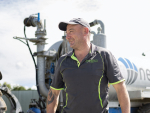
Boosting Crop Production by Spreading Effluent
Tararua district farmer Jamie Harris milks around 400 cows using a split calving system on his farm, Crossdale Dairies.




 increase font size
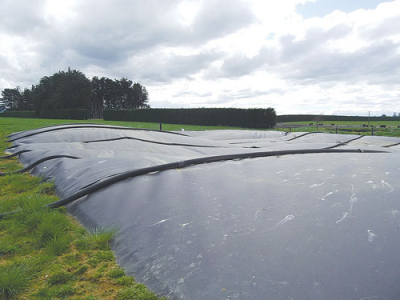 Glenarlea Farm’s biogas recovery system.
A biogas recovery system using methane from dairy effluent to generate electricity and heat water was one of three finalists in the Energy Technology of the Year award in the 2017 Deloitte Energy Excellence Awards.
The system was installed by John Scandrett of Dairy Green Ltd with Fortuna Group Ltd.
The ground-breaking project implementing a prototype methane recovery system on a 950-cow farm in Southland has demonstrated for the first time commercial viability of this technology within a cool climate, says Dairy Green in its award entry.
“Performance has exceeded forecasts, providing 30kW electricity and 60kW hot water, providing for most of the farm’s energy needs, including running an electric farm bike entirely from waste product.
“Dairy effluent storage ponds are known to produce methane, a greenhouse gas more than 21 times worse than carbon dioxide in effect. Despite this the dilute nature of dairy shed effluent means it is not suitable for supplying conventional biogas digesters.
“The Fortuna Group’s Glenarlea Farms 950-cow property in western Southland has successfully demonstrated biogas can be harvested and used to meet a significant portion of the electricity needs and all the hot water needs of a dairy shed.
“The science behind the project was developed by NIWA and monitoring of a Southland dairy shed effluent pond for NIWA by Dairy Green Ltd staff confirmed the commercial viability of methane recovery.”
Dairy Green Ltd was contracted by the Fortuna Group to implement methane recovery and electricity and hot water generation at the Glenarlea Farms property. Scandrett designed the water cooling system.
Venture Southland arranged EECA involvement and funding NIWA’s initial involvement, completing a feasibility study. EECA provided a subsidy.
The project involved building a biogas recovery pond, gas collection and transfer piping and condensate removal. This was followed by filtering and compression and storage so the generator could be run on a standby basis.
Scandrett says five farms in the South Island are interested in the system. They are at the stage of putting a package together for commercial development.
Because of economies of scale the system will suit larger farms better. But possibly two or three farms could come together and have one setup between them.
Scandrett says about 7% of methane losses from the farm are from the effluent pond but a farm with a wintering home probably has about 15% of its methane footprint from stored effluent.
“So covering the effluent and capturing the methane could be capturing 7-15% of the methane from the farm. It is certainly significant as well as being an energy source.”
The nutrients in the effluent are not being affected at all, so there are “a whole lot of pluses” to the system, he says.
Tararua district farmer Jamie Harris milks around 400 cows using a split calving system on his farm, Crossdale Dairies.
Water management is an integral component of sustainable farming practices, according to Watermetrics.
Two farmers and two farming companies were recently convicted and fined a total of $108,000 for environmental offending.
A Taupiri farming company has been convicted and fined $52,500 in the Hamilton District Court for the unlawful discharge of dairy effluent into the environment.
Founded in Germany as recently as 1977, today, the Fliegl Group employs more than 1100 workers, offering an expansive range of transport solutions, from their base in Bavaria.


Waikato milk processor Tatua has again declared a record milk payout to farmer shareholders, leaving other processors in the dust.
A Labour-led Government won’t be bringing back the controversial freshwater rules of 2020.
National’s much-touted free trade deal with India featured in the Rural Issues Debate at Mystery Creek, Hamilton on Wednesday night.
New Zealand's 2026-27 freshwater fishing season has opened, with anglers encouraged to head to rivers and lakes over the coming days as conditions look favourable across much of the country.
Central Otago District Council (CODC) has voted against a plan to spread treated sewage sludge from Cromwell and Alexandra on farmland near Lauder, a decision Federated Farmers says reflects strong opposition from rural residents.
Pāmu has released its FY26 Integrated Annual Report, reporting a Net Operating Profit of $113 million, more than double the $49 million recorded in FY25.
OPINION: It seems Canterbury processor Synlait is still in the doldrums.
OPINION: Get offside with New Zealand First leader Winston Peters at your own peril.




