Boosting Crop Production by Spreading Effluent
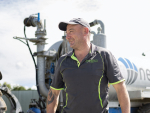
Tararua district farmer Jamie Harris milks around 400 cows using a split calving system on his farm, Crossdale Dairies.




 increase font size
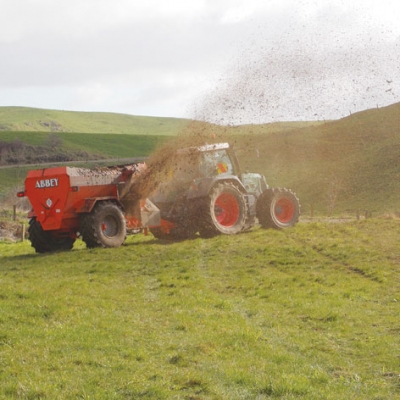 Abbey Multi Spreader.
Hamilton agricultural contractor Greg Langman says his Abbey AP900 multi spreader has handled “everything we have thrown it” in three years of operation, says the supplier, Farmgard.
“We’ve done a lot of work with the spreader which is strong, tough and spreads evenly. The proof is [most of] the clients we work for ring up and say what a great machine it is and what an excellent job it has done.”
Greg and his son John run Langman Agricultural Contracting from Te Pahu, west of Hamilton, offering many services including harvesting, hay and silage, and cartage.
“John added some youthful enthusiasm to the business when he joined me about eight years ago,” Greg says. “Since then we’ve expanded into a whole lot of new areas, including effluent spreading.”
They looked at several spreader makes and models before deciding on the Abbey AP900. “At the time the AP900 was a new concept and there was nothing quite like it on the market. It has proved an excellent machine, giving us full control over the effluent spread.”
The Abbey multi-spreader has a large diameter heavy-duty auger designed to create an even flow of material without clogging. Its drum improves the flow of material, the base of which is fitted with a double skin for chassis strength and durability.
Although dairy effluent is the main by-product spread by the Langmans, they have also used the Abbey for spreading bedding matter from cow stand-off pads, chicken manure prior to maize planting, cleanings from goat and calf sheds, and drain cleanings.
“If it’s spreadable, this machine will handle it.”
They like the spreader’s side delivery, throwing material away from drains and waterways, and down sidelings, with ease.
“The application is precise, eliminating the possibility of effluent leaching into waterways. It is more accurate than a rear discharging spreader, on which the operator has to judge for himself the distance to the water.”
Conversely, the spreader can spread effluent up to 50-60m “when you open it up”, says Greg.
Overall, he finds the AP900 “user friendly” with good visibility during operation.
“It is well suited to New Zealand conditions with large tyres for flotation on softer ground and no hindrance when the machine is working on hills.”
The machine is easy to service, is watertight and can spread effluent with high water content without it draining out of the machine.
The firm also has an Abbey tanker which works in tandem with the spreader.
Tel. 09 275 5555
Tararua district farmer Jamie Harris milks around 400 cows using a split calving system on his farm, Crossdale Dairies.
Water management is an integral component of sustainable farming practices, according to Watermetrics.
Two farmers and two farming companies were recently convicted and fined a total of $108,000 for environmental offending.
A Taupiri farming company has been convicted and fined $52,500 in the Hamilton District Court for the unlawful discharge of dairy effluent into the environment.
Founded in Germany as recently as 1977, today, the Fliegl Group employs more than 1100 workers, offering an expansive range of transport solutions, from their base in Bavaria.

Farmer-owned fertiliser company, Ballance Agri Nutrients is welcoming National’s plan to negotiate security agreements with key supplier countries to protect New Zealand-bound products from export restrictions and greater supply chain certainty.

Carrfields has announced the appointment of Stu Hall to the newly created role of chief operating officer, Carrfields Ltd, reflecting the continued growth of their agribusinesses and the need to ensure the company has the leadership capacity and support in place as it pursues the emerging opportunities ahead.
New Zealand's role is not to compete with Indian growers, according to NZ Apples and Pears.
The potato industry is celebrating the success of two rising stars - James Blair, the 2026 Young Grower of the Year and runner-up and innovation award winner, Amber Davy.
Twenty-eight emerging leaders from across the horticulture sector spent two days last month learning valuable skills and connecting with industry experts.
There are five entrants in this year’s Young Horticulturist of the Year, competing in a series of technical, practical, business and leadership challenges.

OPINION: It seems Canterbury processor Synlait is still in the doldrums.
OPINION: Get offside with New Zealand First leader Winston Peters at your own peril.




