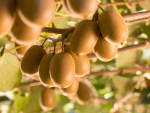
NZKGI Responds to Migrant Worker Exploitation Reports
Where any worker in the kiwifruit industry is mistreated, we expect the authorities to take action.




 increase font size
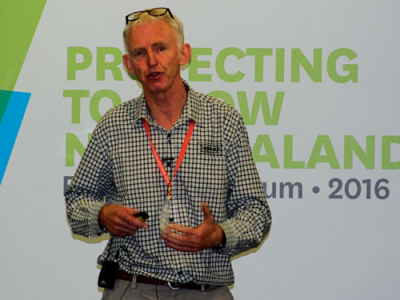 James Trevelyan speaking at the recent BioSecurity Forum.
The first year Bay of Plenty Trevelyans Pack and Cool store introduced ‘lean manufacturing’ it saved the company about $340,000, says managing director James Trevelyan.
The kiwifruit and avocado operation made these savings “by doing the job right first time and concentrating on that unloved matrix, quality”.
“This year we have made our growers over $2 million extra by having lower fruit loss than the industry average, by measuring and getting all those little decisions right,” he says.
Trevelyan told the Biosecurity Forum 2016 in Auckland last month that he lost a big chunk of his orchard and the fruit they were processing during the Psa incursion.
They got through the tough times a continuous improvement programme started nine years ago when Zespri asked if they wanted to be part of a project trialling ‘lean manufacturing’ -- a regime of removing waste, measuring, mentoring, effective information, understanding, solving problems and continuous improvement.
He saw linkages to the five strategic directions of Biosecurity 2025 – the new government biosecurity direction launched at the forum.
“Our largest risk to the business is biosecurity,” he says. The cost to New Zealand horticulture of a single Queensland fruit fly incursion would be $2 million to $400 million.
Trevelyan says his world-class packing and fruit storage facility, operating for nearly 40 years, is effectively a training school that happens to pack fruit.
“How do we do this? We sit together as a group and we have inductions and mentoring and we cater for all the different nationalities.”
They have supervisors who speak different languages and they build teams of 135 people.
They pick star players – mentors – who start later in the day and finish earlier in the night. These mentor teams during their shifts and if management wants to make changes they do so via these people.
“Quality – we always talk quality at work.... Nine years ago quality was something we didn’t really love very much. We always talked about cost and production, we never seemed to talk about quality.”
Now they always talk quality and they measure it.
“I know a really good result is made up of 1000 little decisions. We map all those 1000 little decisions and we see how we are getting on. If the little decisions look good, guess what? The big decision is great.”
On the workshop floor if there’s a good result people are given feedback. Or workers can flick a light switch to ask a question.
They also have a television screen to show a team how they are getting on. The screen rolls around and they chase given standards of quality, production and costs.
“As a team of 135 they are working to balance these three things together. So that is built up of getting all the little decisions right.”
The team leaders will talk about quality with their supervisor four times a day. The team starts to live it.
They ask people what the problems are – “what’s pissing them off”, says Trevelyan. They always tell you. And if they ask for good ideas, they always get a big response.
Then they sit around as a team – a leadership team or affected parties – and put tension into the discussions and talk about the problems and how to solve them.
“Sometimes you’ve got to use your mind rather than your money to solve these problems. There are a lot of gems out there that don’t cost a lot of money. You’ve got to get your mind in the right space.
“In summary, we measure, we ask people what their problems are and we solve those problems,” he says.
Trevelyan says he fully supports the new Biosecurity 2025 strategy.
Where any worker in the kiwifruit industry is mistreated, we expect the authorities to take action.

Kiwifruit growers are watchful but remain optimistic as concerns around the potential effects of the El Niño weather pattern this season.
More signs of a booming kiwifruit sector.
After delivering a strong financial year, rural trader PGG Wrightson says the coming months will depend on customer confidence and weather.
New Zealand growers have always adapted to changing conditions, but one challenge is steadily gaining ground across the horticulture sector: resistance.


Synlait has swung to second-half profit as operations stabilise, but the dairy processor still posted a $75.4m annual loss.
LIC shareholders have elected a new North Island representative to the co-operative's Board, along with five representatives to its Shareholder Reference Group (SRG), following the company's Annual Meeting held in Invercargill.
Farmers across parts of Southland and South Otago are continuing to deal with difficult conditions after a prolonged run of wet weather, with pressure building around feed supply, stock management, pasture damage, farm infrastructure and everyday workloads.
Federated Farmers says it welcomes Labour's commitment to reviewing the Sharemilking Agreements Act, calling on other major parties to do the same.
For Canterbury dairy farmers Sian Meijer and Rick Wobben, wearable technology has become one of their most valuable on-farm tools - helping manage 1850 cows across an expansive, high-performing dairy operation while improving efficiency, mating outcomes and day-to-day decision making.
Fonterra has unveiled its annual results for the 2026 financial year, posting $27 billion in revenue and close to $20 billion returned to New Zealand farmer owners and unit holders.




OPINION: The same mainstream media muppets that brought you Jacindamania in 2017 have been flat out pimping for the Opportunities…
OPINION: Your old mate reckons the atrocious way farmers in the UK are treated by their lords and masters in…




