Fonterra FY26 Results: $9.69 Milk Price, $3.4bn Profit
Fonterra has unveiled its annual results for the 2026 financial year, posting $27 billion in revenue and close to $20 billion returned to New Zealand farmer owners and unit holders.




 increase font size
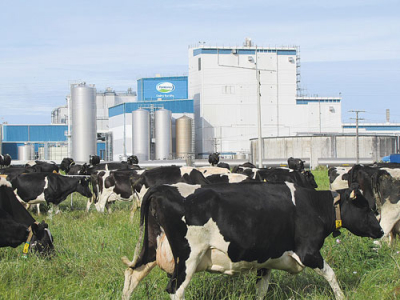 Fonterra’s market share of NZ’s milk production could drop from 84% to 79% over the next 5 years.
Fonterra's market share could fall from 84% to 79% over the next five years, says TDB Advisory, financial and economic advisors.
The ‘New Zealand Dairy Companies Review’ published in April says it seems likely that Fonterra’s competitors, with well-established relationships with farmer-suppliers and offshore customers and profitable operations, will have access to capital to permit them to continue growing at rates of about 10% per annum.
“If, as we assume to be the case, Fonterra grows by 2.5% per annum, Fonterra’s market share will fall from 84% to 79% over the next five years.”
It says the market share of NZ milk processing companies in 2016 was Fonterra 84%, Open Country Dairy 6%, Westland 3%, Synlait 3%, Miraka 1%, Oceania 1% and Tatua 1%.
“The NZ milk processing industry remains predominantly low risk with the large majority of volumes in commodities,” the report says.
“Competitors to Fonterra have improved the transparency of the sector’s risks and returns. The higher-risk strategies (Tatua and Synlait) are being adequately rewarded while at the other end of the spectrum OCD is generating returns materially above its (low-risk) cost of capital.”
Earlier the report says Fonterra’s NZ milk-processing competitors are now well established.
“The competitors’ milk volumes have grown from 600 million litres when Fonterra was established in 2002 to 2.9 billion litres in 2016.
“They now have a combined profitability (EBIT) of over $200m. Interestingly, Fonterra has grown its Australian milk processing volumes to 1.7b litres over the same period and in 2016 delivered a normalised EBIT on its Australian operations of $63m.”
Open Country Dairy is the benchmark commodity processor and Tatua the benchmark value-added processor.
“Both are focussed on their core businesses and delivering higher than expected risk-weighted returns to their shareholders and farmers. Both are paying some of the excess return to farmer-suppliers. When we normalise their cost of milk to Fonterra’s FGMP, their returns on assets in 2016 were 22% (Tatua) and 17% (OCD).
“Synlait is successfully shifting more of its milk into higher margin returns and has the access to capital and confidence from recent returns on assets of above 10% to invest in higher-value manufacturing assets that will continue its growth in volume and margin.
“Westland is the underperforming Fonterra competitor, and it is difficult to see that it could get shareholder support to invest more capital in higher-value processing assets.
“Westland has acknowledged its underperformance and we would expect little milk volume growth until it reduces its costs and regains the confidence of its shareholders.
“The balance sheets of Tatua and OCD show how significantly different their investment in long-term fixed-processing assets is.”
Tatua invests 250% more than OCD for every unit of milk processed, the report says.
“This additional investment is an indicator of the increased risk attached to a value-add strategy and underscores that a higher value-add strategy is not as simple as it sounds. It takes investment in long-term trusted customer relationships and investment in manufacturing assets that cost a lot more than is required for a commodity processor.
“If Tatua’s investment in manufacturing per unit of milk is applied to the other NZ dairy processors (including Fonterra’s NZ milk volumes), an additional $8b in capital would be required across the sector.”
The TBD Advisory report says given comments from the companies “we think it is reasonable to assume the current strategic positioning of the companies will remain the same over the coming few years”.
Fonterra has unveiled its annual results for the 2026 financial year, posting $27 billion in revenue and close to $20 billion returned to New Zealand farmer owners and unit holders.
Fonterra Co-operative Group has confirmed the independently assessed candidates standing for election to its board in 2026.
Fonterra has revised its Farmgate Milk Price forecast for the 2026/27 season, lifting the midpoint and narrowing the range on the back of improving global dairy commodity prices.
Outgoing Fonterra Co-operative Council chair John Stevenson says that it has been a privilege to represent the co-op's farmer shareholders.
OPINION: It seems Canterbury processor Synlait is still in the doldrums.


Federated Farmers says it welcomes Labour's commitment to reviewing the Sharemilking Agreements Act, calling on other major parties to do the same.
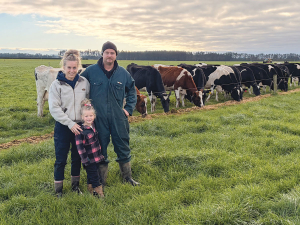
For Canterbury dairy farmers Sian Meijer and Rick Wobben, wearable technology has become one of their most valuable on-farm tools - helping manage 1850 cows across an expansive, high-performing dairy operation while improving efficiency, mating outcomes and day-to-day decision making.
Fonterra has unveiled its annual results for the 2026 financial year, posting $27 billion in revenue and close to $20 billion returned to New Zealand farmer owners and unit holders.
The first major update to the Dairy Cattle Code of Welfare in more than a decade has been released, marking what DairyNZ describes as an important step in ensuring animal welfare standards continue to evolve alongside scientific evidence and on-farm realities.
Ravensdown shareholders have elected Jane Montgomery and Kate Acland to the Ravensdown Board for three-year terms, following a closely contested director election.
Federated Farmers says new legislation replacing the Resource Management Act will cut red tape, unlock investment and help grow New Zealand's export-led economy, after the Planning Bill and Natural Environment Bill passed their third reading in Parliament yesterday.




OPINION: The same mainstream media muppets that brought you Jacindamania in 2017 have been flat out pimping for the Opportunities…
OPINION: Your old mate reckons the atrocious way farmers in the UK are treated by their lords and masters in…