
Pāmu Welcomes Paige Burston as First Foundation Scholar
Pāmu has welcomed Taranaki student Paige Burston as its newest First Foundation Scholar, supporting her journey towards a career in agriculture and animal science.




 increase font size
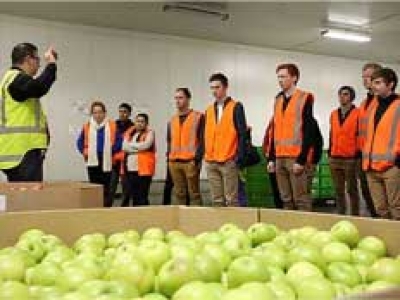 First-year Horticulture Production paper students during a tour of the T&G facilities in Palmerston North.
Although the number of horticulture students has increased, it is still not enough to satisfy demands. Now, industry leaders are connecting with Massey University in an effort to grow graduates in the sector.
Massey University offers the only horticulture degree course at university level in New Zealand. One of the partnerships it has is with Horticulture New Zealand.
Senior business manager at Horticulture New Zealand Sue Pickering gives a guest lecture to students taking the first-year Horticulture Production paper.
She says the horticulture industry earns NZ$7 billion a year, of which NZ$4 billion is from exports. Horticulture “has ambitious goals to grow” and “we need more highly skilled people in our workforce to make that happen.”
She says it has been encouraging to see the number of students increasing. “We need a range of graduates. They will typically become crop or orchard managers, or consultants, or go into a postharvest management role, like managing a packhouse or grower liaison for a big supply company.”
Central regional manager of T&G (formerly Turners and Growers) John Crowther says graduates are the key to unlocking the future of the horticulture industry and is keen to connect with students.
“We have seen the value of having new people with different ideas and up-to-date skills. They provide innovation and help take the industry forward so it competes well in domestic and global markets.”
T&G are supplying fruit for a “fruit of the week” activity with Massey University students as well as giving them a tour of their Manawatū branch.
The first-year Horticulture Production course lecturer, Huub Kerckhoffs, initiated the collaborations. Kerckhoffs says it is a great way to start the week as it immerses students in the topic and helps them get the relevance of what is being presented.
Fruit, vegetable and flower-growing industries cannot get enough of these students, who include several studying by distance, says Kerckhoffs.
“One student attended an industry conference recently and got three job offers while she was there. The industry is changing and taking more of a corporate approach, creating exciting career opportunities here and overseas. The roles include handling logistics, marketing, orchard management, exporting and so on. This means there are more skilled jobs that they need graduates for, and these young people can see some quick career progression.”
The growing interest in studying horticulture was highlighted at the National Horticultural Field Days in the Hawke’s Bay recently with more than 300 secondary school students attending the Pick a Career in Horticulture Expo as part of the event.
T&G is one of a number of organisations providing scholarships for students – in their case offering grants worth $10,000 each to three postgraduate students a year. The total value of scholarships offered to support horticulture and agriculture students at Massey reached over $500,000 this year.
This year 75 students are enrolled in the first-year horticulture paper at Massey, studying on-campus or extramurally. The students do the production paper as part of a Bachelor in Agriscience degree, an Agricommerce degree or a Bachelor of Science majoring in Plant Science.
Pāmu has welcomed Taranaki student Paige Burston as its newest First Foundation Scholar, supporting her journey towards a career in agriculture and animal science.
Where any worker in the kiwifruit industry is mistreated, we expect the authorities to take action.
Kiwifruit growers are watchful but remain optimistic as concerns around the potential effects of the El Niño weather pattern this season.
Researchers at Massey University are using a special piece of scientific equipment to improve the measurement of greenhouse gas emissions from pasture soils.
James Blair, an agronomist for AS Wilcox and the Pukekohe regional champion, has won the 2026 Young Grower national title.



Mark Hooper has been appointed the new chair of NZPork, the industry organisation representing New Zealand pig farmers.

As the India-New Zealand free trade agreement enters into force, New Zealand’s apple industry has reaffirmed its commitment to the long-term development of India’s apple sector.
Fonterra shareholders can begin voting on Tuesday 20 October in the 2026 Board of Directors’ election, a Co-operative Council election in one Ward, and seven Annual Meeting resolutions.
National’s pledge to introduce 19 new national standards shows the party is serious about getting Wellington out of farming, Federated Farmers says.
The National Party’s policies to make it easier to grow fresh vegetables, secure reliable water and energy and simplify farm planning are practical changes that will give growers the confidence to invest, according to Horticulture New Zealand (HortNZ).
Fonterra Co-operative Group chief financial officer Andrew Murray has resigned to take up a role outside the dairy giant.



OPINION: The same mainstream media muppets that brought you Jacindamania in 2017 have been flat out pimping for the Opportunities…
OPINION: Your old mate reckons the atrocious way farmers in the UK are treated by their lords and masters in…




