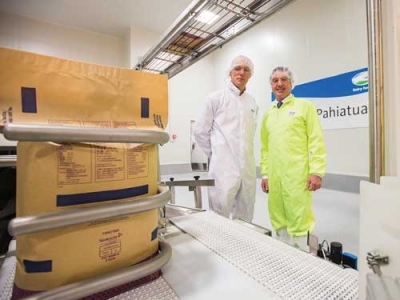
Work on adding a new drier to produce whole milk powder (WMP) started in December 2013 and a few weeks ago the first milk was processed there.
Fonterra’s managing director of global operations, Robert Spurway, says the co-op’s strong sustainability policy applies to all farmers to meet these standards, but even higher standards are imposed at its processing plants.
Visitors and staff working at plants such as Pahiatua are subject to strict and rigorous hygiene and health and safety rules.
Spurway describes the Pahiatua plant as close to a replica of the co-op’s new plant at Darfield, Canterbury. He says they have learned from building that plant, as a result building Pahiatua slightly faster and slightly under budget.
“It has slightly different design aspects at the foundation level, having isolators because of earthquake risk in this region relative to Canterbury. When it gets above the ground the design and technology is almost identical to Darfield,” he told Rural News.
“In commissioning and running [the plants]… we are getting better at it each time. So far this plant start-up has exceeded all our expectations.”
Spurway says the reason for the earthquake strengthening at Pahiatua surprises many people: 18 months ago an earthquake struck, damaging nearby Ekatahuna.
The Pahiatua plant is now processing 3.8 million L of milk per day – up from 1.4m a few months ago. It operates 24/7 and every hour produces 15.5 tonnes of WMP for sale to such markets as Cuba, Sri Lanka and Venezuela.
New technology that recycles water from the drying process is making a difference, says Bill Boakes, the Pahiatua operations manager.
“The water we are taking out of the milk here is cleaned and [used]… as potable water in the process. That’s the first time it’s has been done in a dairy plant in NZ, but it’s done in other parts of the world.”
A waste water treatment plant treats any water that cannot be recycled. This is sprayed onto three nearby Fonterra farms, where nitrogen and other loadings are monitored.
Pahiatua employs 180 staff, 45 of them extra as a direct result of the upgraded plant.