NZ Beef Mince Now Over $24/kg as Export Demand Stays Strong
New Zealand consumers are paying more for beef mince than ever before, with the average retail price now sitting above $24 per kilogram, according to Rabobank.




 increase font size
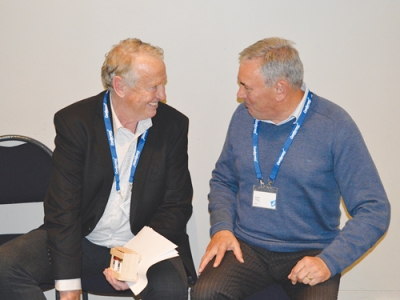 MIE’s John McCarthy and GHD’s Robert Sinclair at last week’s Primary Industry Summit.
Red meat farmer lobby MIE will unveil “a cunning plan” next month to push for the merger of the two major meat co-ops and block foreign investors taking a stake in the businesses.
However, the plan may be too little, too late. The country’s largest meat co-op Silver Ferns Farm (SFF) is talking to a number of parties on capital raising and says it is expected to make an announcement this month.
Rural News understands that the South Island meat processor is well down the track with its capital raising plans.
In fact, this week key SFF staff and board members will meet in Auckland to present to an interested foreign investor – understood to be China-based.
Meanwhile, MIE’s proposal includes a ‘bad bank/good bank’ plan and involves dividing the assets of Silver Fern Farms and Alliance into two entities.
MIE chair John McCarthy last week outlined the plan at the New Zealand Primary Industry Summit in Wellington. He told Rural News the plan would be unveiled within two weeks, providing farmers an alternative to SFF’s capital raising plan, which he claims would open the door for foreign investment in the co-op.
McCarthy suspects SFF is planning to raise $100 million. “I am not privy to the minutiae of the details, but it seems to be for approximately $100 million and given the parlous state of our sector it seems likely that the interest will be from foreign interests. If this is successful the face of this sector will be changed forever,” he told the conference.
“We know from our Cinta survey that over 90% of farmers are not in favour of foreign control of our value chain. We also know that if a foreign flag is hoisted over all or part of our biggest meat company that in all probability it will be the thin end of a wedge. One only has to talk to Australian farmers to get a take on our probable future under foreign and/or corporate dominance.”
Silver Fern Farms chief executive Dean Hamilton was unavailable for comment. However, in a recent newsletter to shareholders, Hamilton says it is “working through a process to consider options for raising new capital in the co-op in order to accelerate our move to a sustainable capital structure”.
“While commercially you would understand it makes sense to maintain confidentiality during the process, we can say there has been interest expressed by a number of parties, which we are progressing, and we expect to make an announcement in the middle of the year.”
McCarthy says MIE’s cunning plan is still at the conceptual stage.
The new company would be a blend of the best and the worst bits of the two coops: a good bank/bad bank scenario, he says.
The bad bank scenario would include writing off 10 plants, costing $104 million oneoff; the good bank scenario would include the remaining assets of the two co-ops. McCarthy expects the new company to be exporting 95% of its products and turning over $4 billion within four years.
He hinted that the plan had “the support of one of the country’s leading banks,” and with its support the group’s financial modelling “shows Newco is not just viable, but would be the catalyst to reinvigorate the entire sector”.
“Such a company would turn over $4 billion plus within three-four years and export 95% of this under new, reinvigorated customer focused branding strategies.
“Most importantly, it would see a significant lift in processor margins, EBIT and NPAT along with substantial increases at the farm gate.”
McCarthy says the new company would have at its core a commitment to what should be the cooperative principles of transparency in pricing, loyalty to its members and scale and size to drive the New Zealand provenance story.
“Its existence would be predicated on committed/contracted supply probably for three to five years. It would include store farmers within its bubble; it would be open to all farmers to join.
“Members would have various payment options, ranging from transfer of shares to writing out a cheque or to a modest levy spread over the period of the contracted supply.”
McCarthy warned that doing nothing was no longer an option. “Tinkering with a solution will simply postpone the inevitable.”
New Zealand consumers are paying more for beef mince than ever before, with the average retail price now sitting above $24 per kilogram, according to Rabobank.

After delivering a strong financial year, rural trader PGG Wrightson says the coming months will depend on customer confidence and weather.
As dairy farmers lock in plans for the upcoming mating season, a partnership between Fonterra and Silver Fern Farms has been formed with the aim of making it simpler to create additional value from calves not entering the replacement herd.
Prime Minister Christopher Luxon says the red meat sector is doing an excellent job promoting our pasture-fed system around the globe.
Applications for Silver Fern Farms Co-operative's next board-appointed farmer director are open.


In Dacre, near Invercargill in New Zealand’s South Island, Bruce Dinnington is running a dairy operation unlike any other.

A free online platform aggregating governance vacancies across rural and regional New Zealand has been launched.
Environment Minister Nicola Grigg has announced details of a new rural plastics recycling scheme.
Agricultural drone operators say that a government decision to allow lower-risk drone work without certification won’t lower standards but drive innovation and efficiency.
OPINION: Warning bells are ringing in the arable sector.
Farmgate lamb prices are down by 8%, beef cattle by 4.5% and farm expenditure up by 4.2%.


OPINION: The same mainstream media muppets that brought you Jacindamania in 2017 have been flat out pimping for the Opportunities…
OPINION: Your old mate reckons the atrocious way farmers in the UK are treated by their lords and masters in…