
Lanaco and Blueair Launch World-First NZ Wool Air Filter
New Zealand wool is reaching new heights as air filtration companies move away from synthetic products to biodegradable alternatives.




 increase font size
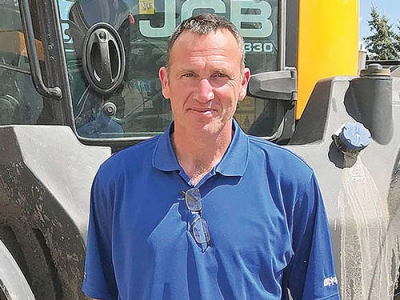 Canadian grain farmer Johannes Heupel developer of the Agra GPS-JD Bridge.
Tractor and harvester manufacturers are cagey about allowing access to their GPS and other software systems — but one farmer may have fixed this issue.
Probably because it means customers will be inclined to stay with a one-colour fleet to eliminate compatibility issues.
Indeed, for as long as we’ve used GPS guidance and yield monitoring/mapping systems, farmers have been dogged by the inability of different brands to ‘talk’ to one another.
But Johannes Heupel, a clever grain farmer (2500ha) in Edmonton, Canada, who runs John Deere tractors and Claas Lexion headers – and is well versed in tech – has developed the Agra GPS-JD Bridge. This connects info from most tractor, header and forager brands to talk to JD’s guidance systems and display screens.
Put simply, the system will allow users to run JD screens and receivers in a competing header or harvester. This enables it to provide auto-steer, use existing A-B and boundary lines, and collect and display yield data.
The technology only uses only 32kb of memory space because its prime focus is data transfer. Any data required for further analysis can be sent to the cloud, a farm computer or JD’s myjohndeere app.
Heupel analysed the codes in the CAN bus systems of most mainstream manufacturers. He then created the device that translates that info into Deere’s software language, to act as a conduit as machines move across the paddock.
In Heupel’s case, the monitor thinks it’s in a John Deere header, although its actually in the Claas Lexion, so all data is translated and processed as normal.
As it’s designed to process only auto-guidance and yield monitoring, there is little chance that overall machine management will be on the radar, given that machines carry such a vast array of differing functions between models and brands.
Systems have so far been designed for Claas, Fendt, MF, Cat, Versatile, Krone and Case Quadtracs.
What is a ‘CAN’ bus?
CAN bus is an integral network designed to transmit data according to a set of protocols.
Controller area network (CAN) is the protocol commonly used on agricultural vehicles as it’s designed to cope with harsh environments.
Built to a global standard, the network allows different control units to talk to each other, sending messages from different parts of the machine to report on function and performance.
Generally, companies don’t provide coding information for how to decipher the documentation systems, which means every piece of data is written in a near-alien language. The exceptions are JCB and Versatile, which provide information to explain what the code being sent between the machine and its control box means.
Deciphering CAN bus information is a difficult procedure due to the thousands of pieces of information sent every second, and because each manufacturer will run different documentation systems, so no data formats are compatible.
New Zealand wool is reaching new heights as air filtration companies move away from synthetic products to biodegradable alternatives.

Generative AI in the workplace, trials in the field, and industry-relevant research took centre stage at this year’s Grape Days events in Central Otago, Hawke’s Bay and Marlborough.
Virtual fencing company Halter is going global but for founder Craig Piggott, New Zealand farmers will always remain their main partners.
Use of agricultural drones by contractors in New Zealand is soaring.
OPINION: New technologies can promise the world but how do we know if they are delivering?


Pāmu has released its FY26 Integrated Annual Report, reporting a Net Operating Profit of $113 million, more than double the $49 million recorded in FY25.

Meat Industry Association data, released alongside the Red Meat Sector conference in Wellington, shows export value climbing across the US, China, UK and Canada.
Applications are set to open for the 2027 Zanda McDonald Award, a trans-Tasman award recognised for identifying and fast-tracking talented young leaders in agriculture and agribusiness.
The Royal New Zealand College of General Practitioners (the College) and Hauora Taiwhenua Rural Health Network are calling for investment in a proposed new training pathway for rural GPs, warning that many rural practices are struggling to recruit while a large share of the existing workforce nears retirement.
Federated Farmers has called on Central Otago District Council (CODC) to drop or vote down a plan to truck sludge from Alexandra and Cromwell to farmland near Lauder, warning it would compound an "outrageous" situation created by a separate council's decision weeks earlier.
Synlait has swung to second-half profit as operations stabilise, but the dairy processor still posted a $75.4m annual loss.




OPINION: The same mainstream media muppets that brought you Jacindamania in 2017 have been flat out pimping for the Opportunities…
OPINION: Your old mate reckons the atrocious way farmers in the UK are treated by their lords and masters in…




