
Low orders, strong dollar soften wool market
The strong dollar, restricted off-shore interest and high volumes of one wool category on offer this week saw local prices ease.



 increase font size
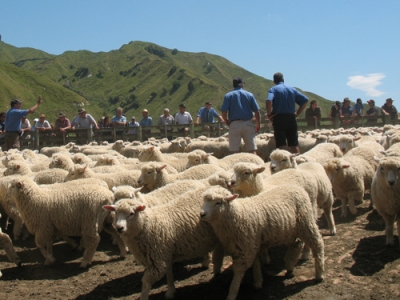
Wool markets remain steady with the latest sale seeing increases of 1 to 2% overall, says NZWSI general manager, John Dawson.
The sale of 6,617 bales was a good result, he says, with an offering of 52% Coarse Crossbred Early Shorn and Second Shear types.
There was good demand for shorter Second Shear types 2 to 3 inch 32 to 35 micron as buyers bid to cover Chinese orders.
The trade-weighted indicator was little changed from the last wool sale on 16th July.
Compared to the South Island sale on 16th July, Fine Crossbred Early Shorn and Second Shear types 3/5 and 3/4 inch were 1% dearer.
A limited offering of Coarse Crossbred Fleece wools were up 1%. Coarse Crossbred Early Shorn and Second Shear 37 to 39 micron 3/5 to 2/4 inch were 1% dearer, while 2/3 inch were firm.
A nominal offering of Crossbred Combing Oddments were in Sellers Favour, while good colour Clothing Oddments increased by 2% with poorer colour remaining firm.
Competition was widespread with China dominating.
Next sale on 30th July comprises approximately 8,000 bales from the South Island.
The strong dollar, restricted off-shore interest and high volumes of one wool category on offer this week saw local prices ease.

Cavalier Wool Holdings (CWH) is 'disappointed but not surprised'.
The Commerce Commission has approved Cavalier Wool Holdings' (Cavalier) application to acquire NZ Wool Services International's (NZWSI) wool scouring business and assets.
The 5100 bales of South Island wools on offer this week through the Wool Services International auction saw strong competition and a 90.5% clearance.
John Dawson, CEO of NZWSI, reports that the South Island sale this week saw a strong market with steady support.


Safer Farms is urging farmers to make sure everyone working on farm has safe, suitable footwear for the job.

The Government is backing work on a community-led water storage scheme that could irrigate up to 11,000 more hectares of the Poverty Bay flats, Agriculture Minister Todd McClay says.
Agri-tech company Herd-i has become a new all-region sponsor of the New Zealand Dairy Industry Awards (NZDIA), the largest nationwide celebration of excellence in the dairy sector.
Four candidates have been confirmed for two director positions on Fonterra’s board.
Returning to the family dairy farm after playing 20 years of professional rugby around the world is no easy task.
After delivering another record farmgate milk price to 100 supplying farms, independent milk processor Tatua is entering thee new financial year with a positive outlook.

OPINION: The same mainstream media muppets that brought you Jacindamania in 2017 have been flat out pimping for the Opportunities…
OPINION: Your old mate reckons the atrocious way farmers in the UK are treated by their lords and masters in…




