Fonterra Elections 2026: Voting Opens Tuesday 20 October
Fonterra shareholders can begin voting on Tuesday 20 October in the 2026 Board of Directors’ election, a Co-operative Council election in one Ward, and seven Annual Meeting resolutions.




 increase font size
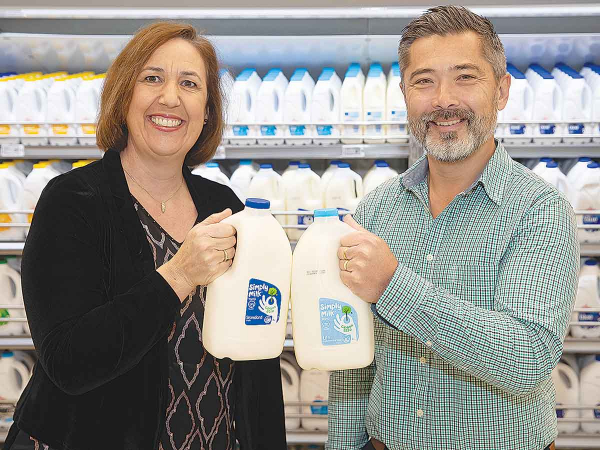 Carolyn Mortland Head of Sustainability Fonterra and Chris Anderson Merchandise Manager Chilled Beverages Foodstuffs North Island.
Fonterra has joined forces with a supermarket chain to deliver what it claims is NZ’s first carbon zero milk.
Simply Milk, a joint project between Fonterra and Foodstuffs North Island, hit supermarket shelves last week. It is now available in New World, Pak’n’Save and Four Squares in the North Island.
Simply Milk has been certified carbonzero through the purchase of carbon credits from Toitū Envirocare, a wholly-owned subsidiary of Manaaki Whenua – Landcare Research, a Government-owned crown research institute. The carbon credits relate to projects undertaken both in New Zealand and overseas. These have then been used to offset the carbon emissions of making the milk.
Carolyn Mortland, director global sustainability at Fonterra, says Simply Milk is a good example of how co-op’s strategy is putting sustainability at the heart of everything it does.
“With Simply Milk we have a practical way to demonstrate their support for the environment,” she claims
“It will enable us to support the regeneration of 7.5 square kilometres of native forest near Kaikoura, as well as renewable energy programmes in overseas markets where Fonterra sells its products.”
Foodstuff’s Chris Anderson says it’s becoming increasingly important to customers to know where their food comes from and that it’s being produced sustainably.
“It’s really exciting to be bringing this first to New Zealand. Simply Milk offers customers the opportunity to purchase their everyday milk and know their choice is making a difference to something that’s really important to them,” says Anderson.
Toitū Envirocare chief executive Becky Lloyd says the carbonzero accreditation process firstly evaluates the carbon emissions of making the milk, right from the farm via store fridge to the customer’s home. The product’s footprint includes farming, production, distribution – as well as eventual consumption and disposal.
Fonterra and Foodstuffs North Island then worked with Toitū to identify projects to offset the emissions.
“We apply a thorough set of principles to determine if a given carbon credit project is real, reliable and meets our quality standards,” says Lloyd.
“Reaching net zero by 2050 requires all New Zealand businesses to start measuring and reducing their emissions now.”
Fonterra shareholders can begin voting on Tuesday 20 October in the 2026 Board of Directors’ election, a Co-operative Council election in one Ward, and seven Annual Meeting resolutions.

Fonterra Co-operative Group chief financial officer Andrew Murray has resigned to take up a role outside the dairy giant.
Four candidates have been confirmed for two director positions on Fonterra’s board.
A record farmgate milk price and strong global demand is laying the foundation for continued growth of organic dairy farming in New Zealand.
Waikato milk processor Tatua has again declared a record milk payout to farmer shareholders, leaving other processors in the dust.


Federated Farmers has welcomed new rural policies released by ACT, saying they align closely with its own election priorities.
Rural Contractors NZ says proposed changes to land transport rules for agricultural vehicles are a welcome response by the Government to out of date regulations which have seen members hit with huge fines.
Alliance is calling for final applications for its 2027 Graduate Programme, with applications closing on Sunday 25 October.
Decades piloting planes has ensured vet and farmer David Hayes is focused on safety. So, after a serious accident while welding on farm, he is sharing his experience so others can learn from it.
Canterbury milk processor, Synlait Milk has confirmed Leon Fung as its chief executive officer.
OPINION: Making it easier to collect rainwater and use it to grow crops and livestock is a no brainer.

OPINION: It seems Canterbury processor Synlait is still in the doldrums.
OPINION: Get offside with New Zealand First leader Winston Peters at your own peril.




