
Diplomatic Incident
OPINION: Your old mate hears an international incident is threatening to blow up the long-standing Anzac alliance as Kiwis and Aussies argue over who wants new Australian resident and former NZ Prime Minister Jacinda Ardern.




 increase font size
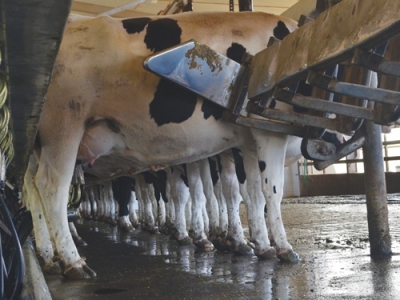 Dairy Australia has launched a website to help farmers monitor the number of lame cows in their herds.
Lameness is estimated to cost Australian farmers at least A$250 for each cow that develops the problem and can greatly reduce cow comfort and longevity.
To help farmers prevent and detect lameness in their herds, Dairy Australia has launched a website with a range of practical and easy-to-use resources. It includes the Healthy Hooves lameness scoring system which enables dairy farmers to monitor the number of lame cows in the herd.
Dairy Australia program development manager Erika Oakes said that by regularly scoring their herd, farmers will be able to assess their current lameness level and set a target for the herd, while assessing what changes need to be made onfarm to reach the target.
"Lame cows are harder to get in calf, have reduced milk production and lower body condition scores. Putting effort into preventing lameness is far better than waiting until cows need treatment," Oakes says.
"We have developed a simple lameness scoring system for our Australian conditions to help farmers prevent lameness and detect issues early."
The Healthy Hooves 4 step lameness scoring system uses different aspects of the cow's movement to detect levels of lameness including stride length, walking speed or evenness, back position and head position.
The website presents short videos that show how to lameness score, including some examples to test how well you score different cows. Other videos cover other aspects of prevention, treatment and management of lameness such as tracks, cow flow, examining lame cows and treatment of common foot problems.
A full colour lameness scoring poster is also available to assist with training staff to use lameness scoring and can be downloaded online or ordered via the website.
How to score lameness
• Scoring should occur at least once a month.
• It should be done at a time when the whole herd can be assessed. Ideally this can be done as the cows are walking out of the dairy after milking.
• Score cows on an even, hard, non-slip surface.
• Look at the foot placement, arching of the back and bobbing of the head to determine the level of lameness.
• Record how many cows score 0 and 1.
• Any cow that is a score 2 or 3 should be recorded and cut out for treatment as soon as possible.
Benefits of regular scoring
• Monitors the effectiveness of your lameness prevention plan
• Allows prompt detection and treatment of lame cows
• Improves cow comfort, herd health and milk production.
Visit healthyhooves.dairyaustralia.com.au for more information.
OPINION: Your old mate hears an international incident is threatening to blow up the long-standing Anzac alliance as Kiwis and Aussies argue over who wants new Australian resident and former NZ Prime Minister Jacinda Ardern.

The way we manage livestock is constantly changing, and the advent of virtual fencing and herding technologies represents a significant advance for pasture-based dairy farming, offering flexibility, efficiency, and improved animal welfare.
Lameness takes toll on cows and farm performance. A lame cow produces less milk, loses condition and takes longer to cycle. The good news? Catching it early and treating it promptly gives her the best shot at a quick, full recovery — and helps keep your herd’s productivity on track.
OPINION: Your old mate hears that at a recent China Business Summit, PM Christopher Luxon delivered a none-too-subtle "could try harder" report card on the red meat industry regarding its exports to China - particularly when compared to Australia.
Twenty four young farmers from South Australia, Western Australia and Tasmania have returned from a recent study tour of Ireland with practical insights, fresh thinking and an expanded network of peers.


Federated Farmers has welcomed new rural policies released by ACT, saying they align closely with its own election priorities.

Rural Contractors NZ says proposed changes to land transport rules for agricultural vehicles are a welcome response by the Government to out of date regulations which have seen members hit with huge fines.
Alliance is calling for final applications for its 2027 Graduate Programme, with applications closing on Sunday 25 October.
Decades piloting planes has ensured vet and farmer David Hayes is focused on safety. So, after a serious accident while welding on farm, he is sharing his experience so others can learn from it.
Canterbury milk processor, Synlait Milk has confirmed Leon Fung as its chief executive officer.
OPINION: Making it easier to collect rainwater and use it to grow crops and livestock is a no brainer.


OPINION: It seems Canterbury processor Synlait is still in the doldrums.
OPINION: Get offside with New Zealand First leader Winston Peters at your own peril.




