The selenium conundrum
OPINION: When Les Hailes was named third form dux at St Kevin's College in Oamaru in 1944 his parents were aghast.




 increase font size
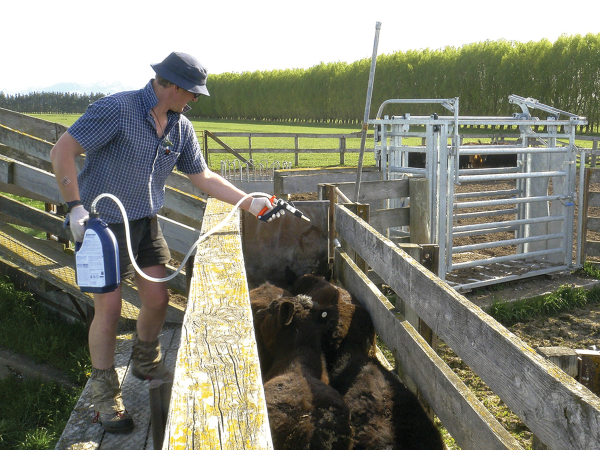 The selenium pour-on was trialled on James Patterson’s property Kintyre in Ranfurly.
Selenium pour-on is back on the market due to demand from veterinarians and farmers for the selenium specific veterinary treatment, says animal health company Inovata.
It says that selenium deficiency has long been a silent threat to livestock productivity and animal wellbeing across the country due to New Zealand’s selenium-deficient soils. From poor growth rates to compromised immunity and fertility in livestock, the production consequences are costly.
Inovata supplies veterinarians with a range of treatments designed for New Zealand’s farming conditions. Through working with veterinarians Inovata developed a single mineral selenium topical trace element treatment for dairy, beef and deer.
Inovata general manager Steve Judd says Inovata Selenium Pour-On is the only selenium-specific pour-on for dairy, beef cattle and deer available in the New Zealand market – filling a need for strategic supplementation of this critical trace element.
“Simple to use selenium pour-on treatment options, which were once a prevalent tool, have been unavailable in New Zealand for several years, leaving veterinarians and their farmer clients with few convenient solutions to address this key driver of animal health,” Judd says.
vets and their farming clients, and they said they were seeing seleniumdeficient stock and asked us to look at developing a pour-on to add to the tools they could prescribe. We listened and brought Selenium Pour-On back.
“Being a topical product, it is easy to use in cattle and deer which can be difficult to inject or treat orally, or for stock on run-off blocks where farmers can’t supplement via water supply, or where prills in fert were just not doing enough across all stock.
“Inovata Selenium Pour-On is ideal for setting up dairy and beef youngstock as it can be easily and effectively applied to match their changing growth rates and protect them as they grow.”
In trial work on beef cattle Selenium Pour-On elevated selenium levels six weeks after treatment. The product has nil meat and milk withholding, enabling it to be used in lactating and pregnant dairy cows and animals that may be sent for slaughter.
“It has been developed to be easy for farmers to work into their stock programmes. For example, Selenium Pour-On can also be used as frequently as once every 3 weeks. This gives farmers the flexibility to fit selenium supplementation around their regular drenching and weighing programmes. It is a simple, reliable way to boost selenium levels, especially around critical times like mating and protecting young cattle.”
The product is formulated to provide the ideal dose for treatment of selenium deficiency – 0.15 mg Se per kg in cattle, 0.3 mg Se per kg in deer, regardless of the weight range of the animal.
“This makes it a good tool for vets to address selenium deficiency and selenium responsive diseases in cattle and deer,” says Judd.
“From a farmer’s point of view Selenium Pour-On is also cost effective. If all you require is selenium supplementation it is cheaper to use a product with only selenium in it because you are not paying for minerals that you may not necessarily need.”
Judd says it is important that farmers work with their veterinarian on the best way to supplement selenium on their farm and what best fits their situation and the stock class to be treated.
OPINION: When Les Hailes was named third form dux at St Kevin's College in Oamaru in 1944 his parents were aghast.
A new generation of organic selenium supplementation will be introduced into New Zealand this year, helping to solve NZ soil's issue of low selenium.
Dealing with the adverse effects of selenium deficiency is a reality for many dairy farmers, with some completely unaware of its effects, says Trina Parker, country manager for BEC Feed Solutions.
ADD SELENIUM to the list of things bugging honey bees.
University of California Riverside entomologists say selenium, a nonmetal chemical element, can disrupt the foraging behavior and survival of honey bees.
Most dairy regions around the country have had a pretty good season so far says Tracy Brown.
Rural leader Mark Hooper has been appointed as an independent director to the NZPork board, bringing extensive farming, governance and advocacy experience to the role.
Opportunity says its land value tax (LVT) is unlikely to force farmers into a position where asset sales or increased debt are required.
Milk powder prices are keeping farmgate prices up, helping processors offset the dip in milk fat prices.
Climate, nature and animal wellbeing make up Fonterra's refreshed sustainability roadmap released last week.
The Government is introducing a new nationwide rural recycling scheme that will significantly increase the recovery of farm plastics from March next year, Minister for the Environment Nicola Grigg announced today.

OPINION: Being a stock manager of a Government MP's farm can come in handy.
OPINION: Groundswell's opinion of the incumbent farm industry representatives isn't high.