Fall Armyworm in NZ Maize: Four Years of Research
Four years since it was first detected in New Zealand, researchers and growers now know much more about management of maize pest fall armyworm (FAW).




 increase font size
New Zealand research and farmer practice shows that pasture-based dairy systems supported by maize silage can be highly profitable. I have written about this topic extensively in the past.
There is an increasing amount of data that shows maize silage systems are not only good for profit but that they are also good for the environment.
I have previously written about the fact that maize is a deep rooting plant capable of drawing nutrients from depth and that because it produces high dry matter yields, it has a relatively high demand for nitrogen (N). In fact, every tonne of maize silage drymatter harvested removes 12-13kg of N from the soil.
Until recently, we were lacking robust New Zealand data on N-loss under a maize silage, catch crop system. Because there is increasing regulatory pressure on farmers to reduce nitrogen losses to water, we felt that it was important to address this.
My colleague Dr Rowland Tsimba and the rest of the Pioneer research team set up a trial specifically designed to measure N loss from a maize silage/winter catch crop system.
The trial began in the spring 2018 and was designed as a randomised complete block design. The plots had maize growing in them over summer, followed by four winter catch crop treatments (fallow, oats, oats + annual ryegrass, annual ryegrass). Nitrogen loss from these plots was measured using an elaborate (and expensive) ceramic sampling cup system and lysimeters placed below the plot at 70cm and 120cm depth.
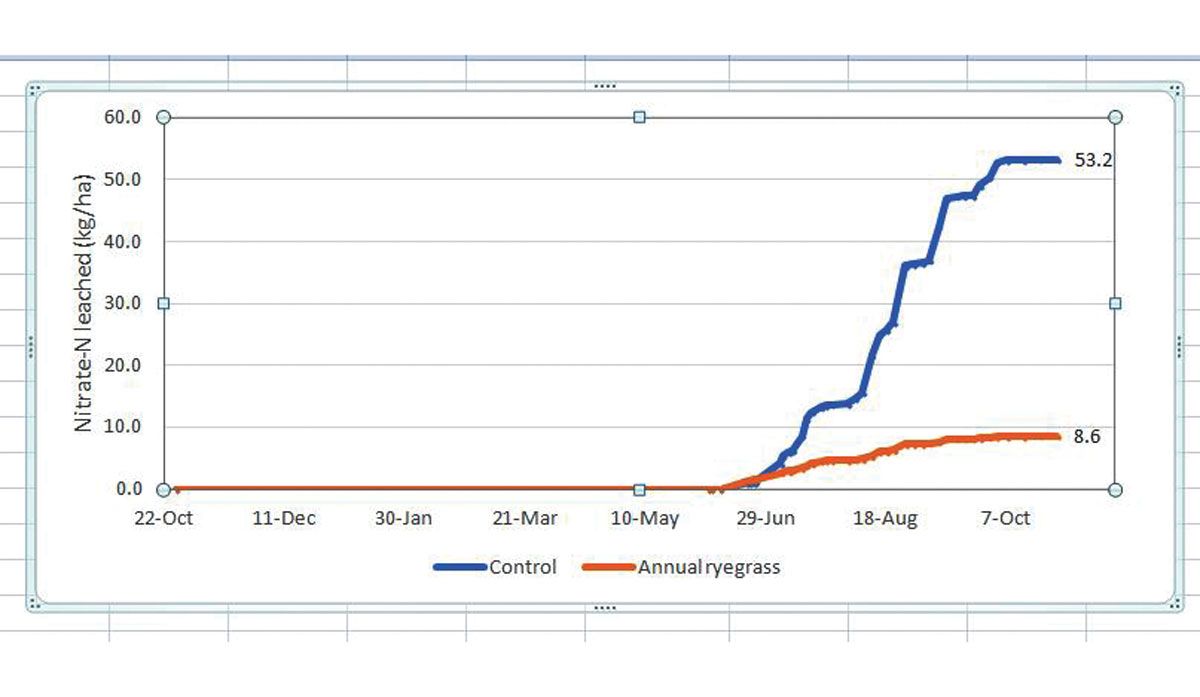
The results of this trial are shown in the graph below.
 |
|---|
|
|
What have we learnt from the trial?
Catch crops work.
The ryegrass and oats catch crop treatments showed a 90% reduction in N loss when compared to the fallow treatment.
Catch crops reduce N-leaching.
Catch crops need water and nitrogen to grow. They help reduce N-leaching by using soil nitrogen and water. The water is used for transpiration and this reduces drainage.
The depth at which you measure N-loss under maize is important.
Because maize is a deep-rooted plant, 70cm (the standard measurement depth for pasture plants) is too shallow to measure N loss from maize silage catch crop systems. In the Pioneer trials the N loss at 70cm was 3.5 times greater than that measured at 120cm.
How deep can maize roots go?
For most of my career, I have parroted what I was told when I first started working with maize, namely that maize roots grow to two thirds the height of the plant. Pioneer's research team wanted to see whether this "fact" was accurate, and they so build a rhizotron is a tall box of soil which has a perspex front closed off by doors to exclude light.
The researchers planted maize at the top of the box and root depth was measured weekly. A week after tasselling, the maize roots had reached the bottom of the box... 3.8 metres deep!
Those who read my column regularly know how important good science is to me. This is great science which will be peer reviewed and published. We plan to use it to help drive the development of sustainable farming systems. There is more to come, so watch this space.
Ian Williams is a Pioneer forage specialist. Contact him at This email address is being protected from spambots. You need JavaScript enabled to view it..
Four years since it was first detected in New Zealand, researchers and growers now know much more about management of maize pest fall armyworm (FAW).
As spring calving cows head into dry-off, the priority shifts to one thing: setting cows up to calve at the target body condition score (BCS).
Early December marks a key transition for many dairy farmers, as weaned replacement heifers head off-farm to grazing.
I recently had the pleasure of attending an AgFirst event in Hamilton where the results of the 2024-25 Waikato-Bay of Plenty Dairy Financial Survey were shared. Based on a 136ha farm milking 379 cows, average farm profit before tax was $405,892, an incredible 286% increase on the 23-24 season.
Over the past few months, I’ve had the privilege of speaking with many farmers at events and one-on-one.


In Dacre, near Invercargill in New Zealand’s South Island, Bruce Dinnington is running a dairy operation unlike any other.

A free online platform aggregating governance vacancies across rural and regional New Zealand has been launched.
Environment Minister Nicola Grigg has announced details of a new rural plastics recycling scheme.
Agricultural drone operators say that a government decision to allow lower-risk drone work without certification won’t lower standards but drive innovation and efficiency.
OPINION: Warning bells are ringing in the arable sector.
Farmgate lamb prices are down by 8%, beef cattle by 4.5% and farm expenditure up by 4.2%.



OPINION: It seems Canterbury processor Synlait is still in the doldrums.
OPINION: Get offside with New Zealand First leader Winston Peters at your own peril.




