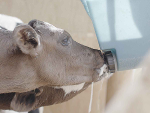
Calf rearers say goodbye to leaky teats, poor feeder fit
Leaky teats and poor feeder fit are now a thing of the past for calf rearers - thanks to the Thriver range of calf teats from Skellerup.




 increase font size
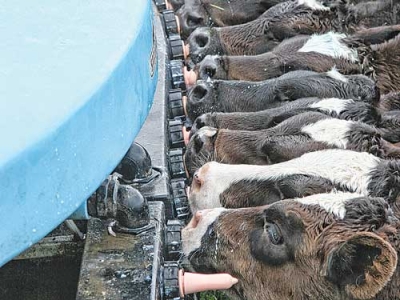 Suckling on Peach Teats help calves growth, according to new trials.
Calves that suckle on Peach Teats have higher growth rates than those which don’t, according to trials commissioned by its maker Skellerup.
Calf rearing expert Dr Bas Schouten was in charge of the project – small-scale observation trials on spring- and autumn born calves, the company reports.
Schouten measured liveweight gain and growth rates in the first seven days, and compared other key calf performance indicators including speed of drinking, curdling, rate of metabolism and lactose absorption.
Dairy farmer and Peach Teat founder Robert McIntyre says the consistency of results for Peach Teats are familiar to hundreds of rearers who have used them for 20 years. “They’re the gold standard for discerning rearers… and this is why,” McIntyre says.
For optimising calf development from day one with a view to rearing better, longer lasting heifers with less genetic wastage, good teats are essential.
“A calf that struggles to get started on a teat never catches up. Think of how much has been invested in getting that calf on the ground in the first place, and the expectation of her future productivity; no wonder using the right teats is a priority.”
If farmers aren’t feeding these calves properly, they’re wasting time and money already spent on producing the calves, and compromising their growth, development and performance.
McIntyre says Peach Teats were used in a recent Swedish study, in which calves were fed specifically for high daily growth rates and achieved up to 1kg liveweight per day.
Peach Teat is designed to simulate natural feeding, squirting milk into the calf’s mouth as during real milk let down, delivering a full mouthful with less effort.
This season Skellerup will donate 10c to the IHC for every Peach Teat sold during June.
The company’s national manager Perry Davis says rearers like the teats because they’re effective, easy to clean and fit virtually any feeder, and they are ideal for sick or weak calves. “With non-valve teats, milk is often pushed back into the feeder and weak calves can struggle to get a proper drink.”
But Peach Teats have two valves: a primary flap valve at the back of the teat, which closes when the calf suckles to ensure milk is squirted out the end of the teat; and a secondary valve, which uses transverse slits at the nipple end of the teat to minimise leaking.
This means the calf does not have to work hard getting milk from the feeder.
Davis says the benefits of Peach Teats can be quantified via a few simple questions: how many calves do I plan to have in each pen? how many people do I have available for the job of looking after those calves?
“If you have two staff raising 500 calves, for example, it’s unlikely those staff will get around the calves more than once a day, so they need to know the calves are all drinking well.
“And how experienced are the workers? How much time will they have for cleaning and hygiene?”
Tel. 0800 475 355
Leaky teats and poor feeder fit are now a thing of the past for calf rearers - thanks to the Thriver range of calf teats from Skellerup.
Rising sales of dairy consumable products helped Skellerup deliver a record net profit of $48 million last financial year.
It's a change of scenery, customer and supply chain for Skellerup’s incoming agri division head, Hayley Gourley.
Dairy rubberware supplier Skellerup is giving its support to I Am Hope, a community group.
Filling the vat with the best milk you can produce is a financial advantage, says milking liner maker Skellerup.



Fonterra has revised its Farmgate Milk Price forecast for the 2026/27 season, lifting the midpoint and narrowing the range on the back of improving global dairy commodity prices.
New Zealand's citrus growers were challenged to build their future on the value embedded in their fruit rather than the volume they produce, at Citrus New Zealand's annual gathering in Gisborne on 17 September.
Leading John Deere technicians and apprentices from New Zealand and Australians were recognised at the recent sixth annual JD Technician of the Year Awards, held in Brisbane.
In Dacre, near Invercargill in New Zealand’s South Island, Bruce Dinnington is running a dairy operation unlike any other.
A free online platform aggregating governance vacancies across rural and regional New Zealand has been launched.
Environment Minister Nicola Grigg has announced details of a new rural plastics recycling scheme.




OPINION: It seems Canterbury processor Synlait is still in the doldrums.
OPINION: Get offside with New Zealand First leader Winston Peters at your own peril.




