
Open Country Dairy Expands Butter Production with New Plant
The country's second largest milk processor, Open Country Dairy, is building a butter plant at its Awarua site in Invercargill.




 increase font size
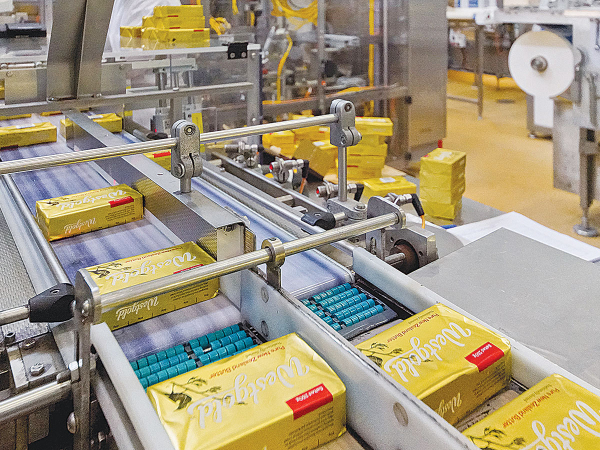 The new plant will produce a range of butter packs from 180g up to 1kg blocks.
A unique gold rush started last week with the official opening of the new $40 million butter plant at the Chinese-owned Westland Milk Products plant on the West Coast.
The plant has already been operating for about eight months, but the official opening by Agriculture Minister Damien O’Connor was delayed because of the Covid pandemic. The new plant doubles the capacity of its butter facility enabling it to produce up to 42,000 tonnes a year.
O’Connor told those at the opening that the investment in the butter plant represented real value for the future of the dairy industry on the West Coast. He says it’s great to see this continued investment by Westland Milk Products.
Westland chief executive Richard Wyeth says the original butter plant built in 1973 has made way for a purpose-built facility that will double its capacity of small-format butter pats with modern, state-of-the-art machinery that still holds true to tradition. The new butter churns were built by the German food and technology company GER and, according to Wyeth, it is world class equipment which still uses traditional churn methods.
Work on installing the new butter plant began at the end of last season, which Wyeth says was challenging.
“We had to stop production in the old plant, take it all out and then shoehorn the new plant into the old building. This building required earthquake strengthening and some asbestos to be removed, so it was a really complicated project putting new plant into old buildings in just four months.”
Wyeth says building the new butter plant was a significant capital investment on behalf of Westland owners, Yili, but without it Westland could not have continued to add the value that it needed to in order to be successful. “Installing the new butter plant was fundamental to us delivering a good result going forward,” he says.
And deliver it has, with the company posting a profit for the first half of the financial year – a $40 million improvement over the same period last year and the company’s strongest first-half-year result in seven years. Wyeth says that’s a $14 million improvement on last year.
The new plant incorporates some new technologies, especially in the packing area. It is now producing a range of butter packs from 180g up to 1kg blocks. These are being sold on the NZ market but also being exported to Australia and the US.
“We have no intention of taking our foot off the accelerator as we continue to execute our five-year business strategy,” says Wyeth. “The progress we have achieved one year into the plan has been fantastic. It’s a result that everyone involved with Westland should be extremely proud of.”
Wyeth praised the work that Westland’s original staff contributed towards the heritage of the company as well as the efforts of his current team. He also praised suppliers and partners for helping turn around the company’s performance in the first half of the financial year.
“The team has really worked hard to deliver not only a great outcome in this facility, but across the business to drive the Westgold brand into new markets. We acknowledge their work, and the work of everyone across the business who has worked with Westland since the butter plant was first built in 1973,” he says.
The country's second largest milk processor, Open Country Dairy, is building a butter plant at its Awarua site in Invercargill.
Westgold butter has been named New Zealand's tastiest in a blind tasting conducted by Consumer New Zealand.
Yili's New Zealand businesses have reported record profits following a major organisational and strategic transformation.
A day after selling its consumer businesses, Fonterra has settled a civil claim, filed by Greenpeace, out of court.
OPINION: Cheaper US butter on New Zealand shelves isn't impressing everybody.


Alliance is calling for final applications for its 2027 Graduate Programme, with applications closing on Sunday 25 October.
Decades piloting planes has ensured vet and farmer David Hayes is focused on safety. So, after a serious accident while welding on farm, he is sharing his experience so others can learn from it.
Canterbury milk processor, Synlait Milk has confirmed Leon Fung as its chief executive officer.
OPINION: Making it easier to collect rainwater and use it to grow crops and livestock is a no brainer.
As part of its Election 2026 coverage, Rural News asked political parties how they would help pull the arable sector out of the doldrums. Here's what they said:
Farmers are being encouraged to rethink how they manage waste on farm with the launch of ruralwastesorted.co.nz, a new website bringing together practical tips, real farmer experiences and resources.

OPINION: It seems Canterbury processor Synlait is still in the doldrums.
OPINION: Get offside with New Zealand First leader Winston Peters at your own peril.




