Fonterra Elections 2026: Voting Opens Tuesday 20 October
Fonterra shareholders can begin voting on Tuesday 20 October in the 2026 Board of Directors’ election, a Co-operative Council election in one Ward, and seven Annual Meeting resolutions.




 increase font size
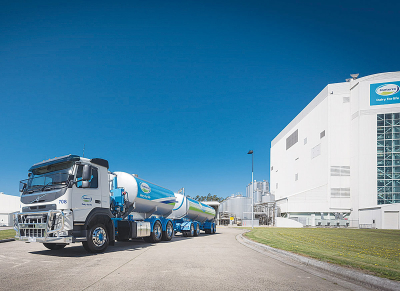 Fonterra’s Australian milk collection in July was down nearly 30%.
Fonterra's woes are also worsening in Australia.
The cooperative kicked off the season there with a 28.9% decline in milk production as it continues to lose its collection share.
This was the percentage drop for the first month of the season, July, versus the same month last year. It represents a small percentage of the full year’s collection, Fonterra says in its latest Global Dairy Update.
However it admits its share of the milk collection continues to decline, impacted by intense competition for milk supply and the continued impact of the poor conditions on farm.
“The drought has led to an increase in cow cull rates, a significant number of farm retirements and a continuation of historically high input costs resulting in a material reduction of the Australian milk pool in FY19 (full year) versus FY18.”
Australia’s overall milk production is dropping but nothing like as steep as Fonterra is seeing
Australian milk production in the 2018-19 season (ending June 30, 2019) was 8.8 billion litres, down 5.7% from 9.3b litres the previous year, says Bonlac Suppy Company chairman John Dalton. This production is noticeably greater than Dairy Australia’s previous estimate of a fall of 7-9% to 8.45-8.65b litres.
Dairy Australia anticipates a further drop in national milk production of 3-5% to 8.3-8.5b litres during the 2019-20 season, due to continued high input costs and the reduced size of the national herd.
In New Zealand Fonterra’s milk collection was up 2.2% in July versus the same month last year and 4.7% for the season to the end of July. Season-to-date collections represent only about 2% of full season collections.
NZ’s total production was up 4.8% for July. Fonterra’s South Island collection is up 8.6% for the season to date and the North Island is up 4%.
The update showed that European Union (EU) and US production is flat.
The EU was up just 0.1% for the 12 months to June 2019 and the US was up just 0.3% for the 12 months.
Exports for the 12 months to the end of June from NZ grew by 8.4%, from Australia for the same period by 5.1% and the EU by 3.7%, but the US was down by 6.3%.
Imports into the Middle East and Africa showed large declines of 24.5% for May versus the same month last year and 11.4% for the year to the end of May.
Asia, Latin America and China imports continued to grow, with China up 8.4% for the 12 months to June this year.
No China effects
Talk of economic slowdown in China has not yet affected dairy demand, says Open Country chief executive Steve Koekemoer.
“We will deal with it if and when it happens,” he said.
Results of the September 3 Global Dairy Trade (GDT) auction support a view of price stability within the whole milk powder product range, he says.
Participation levels were the highest in at least the last 18 months which is a good sign for demand.
“The dairy industry is not an easy industry to be in and volatility has been a constant for many years,” he said.
“The food industry, like many, is changing fast and requires businesses to review their investments and strategies regularly. Our strategy and investment decisions remain sound for dairy ingredients for the foreseeable future.”
Open Country says it is looking towards another solid year and that its projects are tracking well. It is well positioned with its large customers and multinationals, who now “view us as a long term strategic partner”.
Fonterra shareholders can begin voting on Tuesday 20 October in the 2026 Board of Directors’ election, a Co-operative Council election in one Ward, and seven Annual Meeting resolutions.

Fonterra Co-operative Group chief financial officer Andrew Murray has resigned to take up a role outside the dairy giant.
Four candidates have been confirmed for two director positions on Fonterra’s board.
A record farmgate milk price and strong global demand is laying the foundation for continued growth of organic dairy farming in New Zealand.
Waikato milk processor Tatua has again declared a record milk payout to farmer shareholders, leaving other processors in the dust.


Federated Farmers has welcomed new rural policies released by ACT, saying they align closely with its own election priorities.

Rural Contractors NZ says proposed changes to land transport rules for agricultural vehicles are a welcome response by the Government to out of date regulations which have seen members hit with huge fines.
Alliance is calling for final applications for its 2027 Graduate Programme, with applications closing on Sunday 25 October.
Decades piloting planes has ensured vet and farmer David Hayes is focused on safety. So, after a serious accident while welding on farm, he is sharing his experience so others can learn from it.
Canterbury milk processor, Synlait Milk has confirmed Leon Fung as its chief executive officer.
OPINION: Making it easier to collect rainwater and use it to grow crops and livestock is a no brainer.


OPINION: It seems Canterbury processor Synlait is still in the doldrums.
OPINION: Get offside with New Zealand First leader Winston Peters at your own peril.




