Fonterra Cuts 2026/27 Milk Price Forecast to $9.25
Fonterra has reduced its forecast 2026/27 Farmgate Milk Price.




 increase font size

Fonterra has welcomed Government announcements on the 2011 Review of New Zealand's Emissions Trading Scheme, while restating its commitment to emissions reductions.
"We recognise that climate change is real and that global emissions must be reduced. Fonterra will continue to target a 20% reduction in emissions intensity right across its supply chain by 2020," says Fonterra's Group GM Global Sustainability, Bruce Donnison.
"But at the same time, we have been concerned that applying additional carbon costs on agriculture here, when they are still not faced by the majority of producers elsewhere in the world, simply undermine the competitiveness of the New Zealand agricultural sector - our most important export sector."
He says with current global financial conditions, the decision to hold the one for two obligations (one New Zealand Unit for every two tonnes of emissions) was timely, particularly given the agricultural sector's consistent and considerable contribution to exports. It also recognised New Zealand's comparative efficiency in producing low carbon food for a growing global population.
Donnison stressed the review would not be taken as a signal to ease up on efforts to mitigate agricultural emissions.
"The bulk of emissions are on farm and we need to tackle them there. We have consistently held the view that providing information and supporting our farmers to reduce emissions will always have more impact than increasing carbon costs.
"Our farmers have contributed nearly a quarter of the $43 million being invested by New Zealand in mitigation research and want practical solutions. This work will continue, as will the efforts being made in Fonterra's milk processing plants to drive down emissions, especially through energy efficiency."
Donnison says New Zealand Fonterra dairy farmer suppliers were already directly paying their way in the ETS, with $3,700 a year in carbon costs for fuel, energy and their share of the carbon costs being paid by Fonterra for processing emissions. This compares to a typical household's costs of around $133 a year.
"Without the decisions announced today, and if prices rose back to the expected $25 per New Zealand Unit, the ETS would have cost the average dairy farmer $8000 per annum from 2015."
Fonterra has reduced its forecast 2026/27 Farmgate Milk Price.
Fonterra's Whareroa site took home the prestigious Directors Award at the co-op's 'Oscars of Manufacturing', while Clandeboye led the way with multiple wins at this year's Best Site Cup.
After 25 years it is the right time to step away, says Colin Glass, the retiring chief executive of New Zealand's largest private corporate dairying company, Dairy Holdings.
Fonterra is strengthening its foodservice presence in China with the launch of a new cream for professional bakeries at Bakery China 2026 in Shanghai.
OPINION: To a chorus of crying greenies, and not a minute too soon, the Government has moved to put the courts back in their place through proposed amendments to the Climate Change Response Act 2002, intending to limit climate litigation claims such as Smith v Fonterra, in the interests of providing greater certainty for vital industry.


Fonterra has reduced its forecast 2026/27 Farmgate Milk Price.
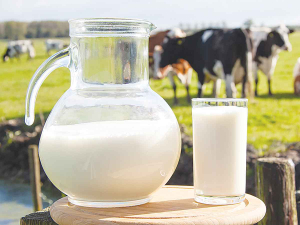
New Zealand dairy farmers are set to be the first in the world to receive access to a new digital physical milk pricing tool that enables them to fix the price for their physical milk.
State farmer Pāmu is opening its farm gates this summer in an effort to give the rural sector the opportunity to see how large-scale, multi-system farming is delivering productivity and profitability across New Zealand.
A five-year study has found that the cost of reducing emissions without technology may be significant and unsustainable for Northland dairy farmers.
DairyNZ says Waikato farmers need certainty on Plan Change 1, but they say that certainty must be matched with practical, workable rules and a clear transition that doesn't get ahead of the new resource management system currently under review.
While the Government has moved quickly to make commercial hauliers' lot easier during the current fuel crisis, they appear to be stuck in the creep box when it comes to the agricultural industry.


OPINION: No one messes around with Winston Peters, more so in a general election year.
OPINION: Staying on Federated Farmers, this week's annual general meeting in Auckland is shaping up to be an interesting one.