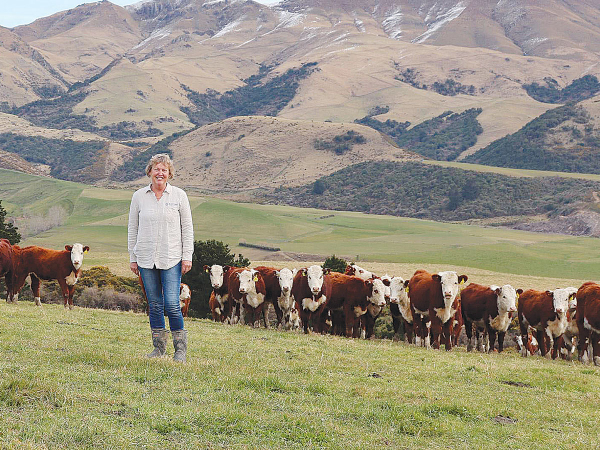
A Canterbury Hereford stud specialising in providing beef genetics for the dairy industry is claiming a major breakthrough in breeding for more environmentally friendly animals, with reduced urinary nitrogen emissions.
Bluestone Herefords, run by Yvonne and Ben Lee near Cave in South Canterbury, have launched the development under the name “Green Bull”.
They say they were aware of CRV Ambreed’s work on developing low nitrogen-emitting dairy genetics, using the measured concentration of urea nitrogen in milk (Milk Urea Nitrogen, or MUN) as the predictor of urinary nitrogen.
However, testing milk is impractical in beef breeds so Bluestone have pioneered testing for Blood Urea Nitrogen (BUN) instead. They believe they are the only beef breeders in New Zealand to do so.
Results have found a strong correlation between BUN and MUN.
Yvonne Lee told Dairy News that the work is important because 90-95% of their business is supplying beef bulls and beef semen (sold though CRV, Worldwide Sires and ST Genetics) to dairy farms wanting to maximise the value of those calves not intended for herd replacement.
She says about 70% of New Zealand’s beef production originates on dairy farms.
“Reducing urinary nitrogen is important because about 20% of nitrogen in urine leaches into groundwater while some is released to the atmosphere as the greenhouse gas nitrous oxide.”
In a media statement, Bluestone noted that Lincoln University researchers found that cows with genetics for low MUN excrete less urinary nitrogen but have more nitrogen in the milk in the form of valuable protein rather than urea.
The work has been underway for about six years.
They say the data indicates that animals do differ genetically for BUN, and that this is heritable and should pass on low- BUN characteristics to their progeny.
Lee says the data also suggests that animals with low BUN breeding values tend to have higher breeding values for 400-day, 600-day and maternal liveweight traits – which means low-BUN animals may be partitioning dietary nitrogen from the urea pools (milk, blood, and urine) and into growth.
She calls that a "win-win".
Lee says a dairy farmer is generally looking for low birthweight, short gestation, easier calving animals.
“And then what we’re also trying to ensure is that when they onsell them, then there is the carcass data and the growth.
“We say the future will be the Green Bull because there’s a lot around about how much nitrogen is emitted into the ground and waterways and nitrous oxide.”
Further research is still needed, with Bluestone now trying to initiate a programme to quantify the BUN-UN relationship.
They are not yet marketing semen with low- BUN genetics but for the last two years have identified the best low-BUN animals in their annual bull sales.
“This year we are marketing seven bulls whose breeding values for BUN are significantly below average and these are identified in the catalogue. We are now including BUN as a key part of our breeding programme.”
Lee says pending changes to the dairy industry will only increase interest in higher-value, low nitrogen-emitting calves. She cites the upcoming ban on live exports, and Fonterra’s directive that all nonreplacement calves from their supplying farms enter a “value stream” rather than be euthanised on-farm.