What Would Synlait Be Worth to Fonterra or a2 Milk?
Speculation of a possible joint move by Fonterra and a2 Milk to buy Synlait raises a much bigger strategic question, says agribusiness expert Dr Nic Lees.




 increase font size
 Dr Paul Cheng, Lincoln University.
With the more intensive farming practices used currently there is a need to ensure optimum animal health and pasture health for long-term environmental sustainability.
Research by livestock production scientists from the faculty of agriculture and life sciences at Lincoln University was undertaken to investigate whether incorporating deep-rooted forage herbs such as plantain or chicory into the pasture mix would help animal production and sustainability on farms.
"For dairy farmers, in particular, it is very important that their heifers, which will be the next year's milking animals, are in the best physical condition as possible at mating and calving," said Dr Paul Cheng, the principal investigator.
"New Zealand farmers are aware of the need to reduce any negative environmental impact from livestock farming to as low as possible so we included in the trial an investigation into whether a change in diet would reduce the excretion of urinary nitrogen, a major contributor to greenhouse gas emissions and nitrate leaching on farms.
"We were delighted to find that the herbage mixtures reduced urinary nitrogen extraction compared with the traditional pasture. This showed the potential for such herbs to mitigate the environmental impact of livestock farming," said Cheng.
"However, while plantain mixtures supported similar liveweight gains of the heifers compared with traditional pasture, chicory-fed heifers had limited liveweight gains."
This trial at Lincoln University's Ashley Dene research farm involved short-term autumn and spring trials using 56 Friesian x Jersey heifers in 2014. The heifers were divided into five dietary treatment groups grazing individual swards: 100% chicory, 100% plantain, conventional perennial ryegrass-white clover pasture, 50:50 pasture – chicory, and 50:50 pasture – plantain.
Measurements were taken of the forage and animals before and after grazing to record the responses to each of the diets.
A second trial, in 2015, using the same herbs showed that using chicory and plantain in a mixture with perennial ryegrass-white clover at proportions of 25% and 50% in the diet had the potential for use as a mitigation tool to reduce the environmental impact from dairy heifer-rearing systems in autumn and spring. Similar to the 2014 trial, liveweight gains of the heifers grazing chicory mixtures were low relative to the other groups.
"While we were pleased with these results we still don't know what the mechanisms are that determine the lower urinary nitrogen concentration and nitrogen excretion that we observed from dairy heifers grazing pasture containing plantain compared with those grazing perennial ryegrass-white clover pasture," said Dr Grant Edwards, professor of dairy production at the university and team leader for this project.
"Further studies are needed where dietary intake can be controlled more accurately to determine the mechanisms leading to the differences in urinary nitrogen excretion," he said.
Designing and running the trials were Paul (Long) Cheng, Jeffrey McCormick, Grant Edwards, Aimi Hussein, Chris Logan, Omar Al-Marashdeh, Miriam Hodge and Hazel Carr from Lincoln University and David Pacheco (AgResearch).
Speculation of a possible joint move by Fonterra and a2 Milk to buy Synlait raises a much bigger strategic question, says agribusiness expert Dr Nic Lees.

Lynnette Hudson's 30-year obsession with Pinot Noir was sparked working vintage in Burgundy, seeing how subtle changes in terroir were expressed in the glass. It was, she says, "an elightening moment in every way".
A four year trial has reaffirmed that mixing plantain into dairy pastures can help reduce nitrogen losses to freshwater while maintaining milk production and profitability, say researchers.
Twenty five secondary school students from around New Zealand recently completed a three day residential programme designed to explore career opportunities across the food and fibre production supply chain.
A Lincoln University student is set to become the first person to contest both the Young Viticulturist and the Young Winemaker national titles in one year.


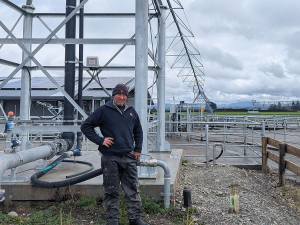
Converting a longstanding cropping farm to dairy was the only way to ensure the land stayed in the family long term, says new dairy farmer Rod May.

As the election heats up, Organics Aotearoa New Zealand (OANZ) has launched its election scorecard designed to help voters wanting to support policies that grow organic and New Zealand's organic sector.
A 'tsunami' of milk from key exporting countries is winding down and this may be good news for New Zealand dairy farmers.
Will the good times last? That's one of the key issues to come out of the latest Federated Farmers confidence survey.
Outgoing Fonterra Co-operative Council chair John Stevenson says that it has been a privilege to represent the co-op's farmer shareholders.
Have a plan in place for your cows and staff.



OPINION: It seems Canterbury processor Synlait is still in the doldrums.
OPINION: Get offside with New Zealand First leader Winston Peters at your own peril.




