
Ravensdown Elects Montgomery, Acland to Board
Ravensdown shareholders have elected Jane Montgomery and Kate Acland to the Ravensdown Board for three-year terms, following a closely contested director election.




 increase font size
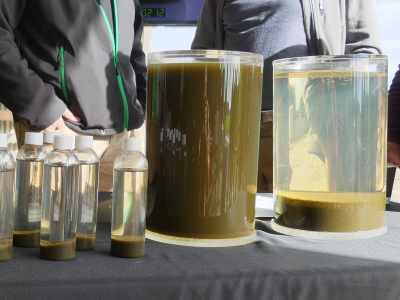 ClearTech binds effluent solids together to settle them out from water.
Ravensdown's ClearTech dairy effluent treatment system has won first prize in the South Island Agricultural Field Days’ Agri-Innovation Awards.
ClearTech uses a coagulant to bind effluent solids together to settle them out from water. Effluent is then separated into clear water that can be used for yard washing or irrigation, and a more concentrated sediment-laden stream which goes to the effluent pond for eventual spreading on pasture.
It reduces freshwater use, helps existing effluent storage to go further and reduces environmental and safety risks.
Research has shown that the process kills almost all harmful bacteria in both the clear and concentrated sediment streams. It also changes phosphorus content in the sediment stream into a less reactive form, with environmental benefits when spread on pasture.
The system is the work of Ravensdown staff and Lincoln University professors Keith Cameron and Hong Di. A pilot plant is operating at the Lincoln University Dairy Farm and other pilots are now being set up.
“Farm dairy effluent is 99% water,” said Ravensdown’s product manager Carl Ahlfeld.
“When the particles can be separated, this means cleaner water to wash down the dairy yard or irrigate onto paddocks and less volume of effluent that has to be stored and used safely.”
Ahlfeld said the dairy sector’s nutrient and bacterial impacts on waterways are causing it to “cry out for workable solutions that help reduce risk, improve reputation and be cost effective”.
The judges commented on the calibre of entrants and were impressed with the joint development of ClearTech.
Meanwhile, this year’s field days also introduced a new Smart Farming Award, won by Ballance Agri-Nutrients’ for its environmental planning tool MitAgator.
Chief executive Mark Wynne said MitAgator would change New Zealand farming for the better.
“It gives farmers a speedo on their dashboard that takes the guesswork out of ‘farming within limits’ by mapping hotspots of the four key water contaminants nitrogen, phosphorus, sediment and E.coli pathogens.
“This tool is tailored for today’s farming because it shows where to spend to achieve the greatest environmental gain. Farmers know where the real risks are and where they can make the biggest impact for every dollar they spend, whether by fencing a stream or building a wetland.”
The judges also awarded an Emerging Technology award to Halter, an Auckland and Morrinsville firm that was a finalist in the Agri-Innovations and Smart Farming awards.
Halter, which has close links with Rocket Lab, is developing a system of solar-powered and GPS-enabled cow collars to monitor and remotely control dairy herds.
The company’s chief, Mark MacLeod-Smith, remarked that farmers now use motorbikes, fences, dogs, etc – all audible and visual cues that tell a cow where she can and can’t go.
“We use a combination of sound and vibrational cues to the collar to essentially elicit the same behavioural response.”
Irrigator wing might even fly
South Canterbury farmer Greg Lovett admits with a wry smile that he doesn’t yet know if his iWing device, designed to stabilise and hold down irrigators at risk of toppling in high winds, actually works.
The iWing (Irrigator Wing) was runner-up in this year’s South Island Agricultural Field Days Agri-Innovation Awards.
Lovett developed it after a huge wind storm in 2012, when irrigators on his and many other farms on the Canterbury Plains were bowled over and destroyed.
“We don’t know for sure because while we’ve had strong winds, those that took out all our irrigators went up to 127km/h; we have not a had a wind [like that] since then,” says Lovett. “It’s insurance.”
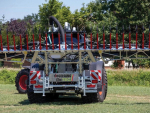
The device consists of a galvanised steel wing shaped like an inverted hang-glider and mounted on a frame bolted to each set of an irrigator’s wheels. On a lateral irrigator, the wings would be mounted on the side facing the prevailing winds; a pivot would have wings on each side to account for its rotation.
Lovett’s idea came after he considered other ways of holding down an irrigator including ballasts and anchors, which would be costly, labour-intensive and require taking the irrigator out of use.
Ashburton engineer and renowned kite designer Peter Lynn was instrumental in the design.
“Some things about the wing I thought were not right, but he knows more about wind than I do,” said Lovett.
Lovett has now installed iWings on the 100 irrigator spans on his 1000ha farm at Wakanui, near Ashburton, where he grows carrots, onions and potatoes. They are manufactured in China.
Lovett says the hardest part was finding someone willing to do the galvanising, because that process tends to buckle the thin and subtly shaped wings.
“If someone rings up and wants 100 wings I can make ’em.”
The price is yet to be determined.
Ravensdown shareholders have elected Jane Montgomery and Kate Acland to the Ravensdown Board for three-year terms, following a closely contested director election.
OPINION: It appears to be difficult for people who haven’t tried to run a business to understand the difference between assets and cash.
OPINION: In the 1980s, concern was expressed in West Germany about the falling birth rate. Some simple analysis was performed by Professor Helmut Sies, physician and biochemist at Dusseldorf University. His letter ‘A new parameter for sex education’ was published in Nature in 1988:
When it comes to annual rebates, it's been a long time between drinks for Ravensdown shareholders.
Ravensdown has reported a net profit before tax and rebate of $50.1 million for the year ended 31 May 2026.


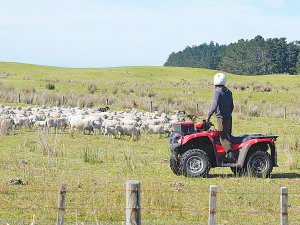
Farmers across parts of Southland and South Otago are continuing to deal with difficult conditions after a prolonged run of wet weather, with pressure building around feed supply, stock management, pasture damage, farm infrastructure and everyday workloads.
Federated Farmers says it welcomes Labour's commitment to reviewing the Sharemilking Agreements Act, calling on other major parties to do the same.
For Canterbury dairy farmers Sian Meijer and Rick Wobben, wearable technology has become one of their most valuable on-farm tools - helping manage 1850 cows across an expansive, high-performing dairy operation while improving efficiency, mating outcomes and day-to-day decision making.
Fonterra has unveiled its annual results for the 2026 financial year, posting $27 billion in revenue and close to $20 billion returned to New Zealand farmer owners and unit holders.
The first major update to the Dairy Cattle Code of Welfare in more than a decade has been released, marking what DairyNZ describes as an important step in ensuring animal welfare standards continue to evolve alongside scientific evidence and on-farm realities.
Ravensdown shareholders have elected Jane Montgomery and Kate Acland to the Ravensdown Board for three-year terms, following a closely contested director election.

OPINION: It seems Canterbury processor Synlait is still in the doldrums.
OPINION: Get offside with New Zealand First leader Winston Peters at your own peril.




