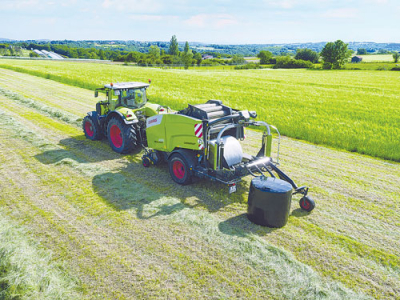
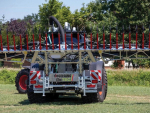
Harvesting specialist Claas has developed a new internal wrapping system for its Rollant 400 Uniwrap balers that will slash processing time and film costs.
The new process allows 1.2m wide x 1.25-1.35m diameter round bales to be wrapped inside the chamber with film instead of net wrap.
In operation, once the bale has reached the desired size it is automatically wrapped in up to eight layers of film which overlaps the edge of the bale by up to 10cm. The overlap removes the need to apply six layers of film on the wrapping table, significantly reducing the amount of film required to produce an airtight seal.
Claas Coatex film (17 microns thick in a 1.4m wide x 2000m long roll) is ideal for use with Rollant 400 Uniwrap balers.
The number of layers applied in the chamber and the extent of film stretching can be adjusted ‘on the go’ from the tractor cab. In use, operators can change from net to film wrapping in a few minutes thanks to a new roll ramp fitted as standard at the side of the machine.
The foldable ramp allows the film rolls, which weigh up to 50kg each, to be easily loaded into the wrapper.
A notable advantage of the system is the removal of the laborious task of separating netting and film once the bale is opened, resulting in easier handling and disposal of the bale wrap.
The new Rollant 400 Uniwrap baler/wrapper with variable film and net wrapping will be available with 2018-delivery machines.
Also available for the new season will be an optional feed rake system on the Claas Rollant 620 round baler.
Said to be ideal for smaller farms harvesting hay or straw on difficult, uneven or sloping terrain, the addition of the rake will increase the baler’s versatility and help to improve forage quality by continuously pulling crop off the rear of the pick-up and feeding it into the bale chamber.
The rake treats the crop gently without the need for a cutting system, said to significantly reduce dust and help produce top-quality feed such as that required by horses.
The Rollant 620 has a pick-up width of 1.85m and a bale chamber of 1.5m diameter. Its slim-line drawbar allows a clear view of the pick-up and enables the driver to monitor the crop flow.
The new Rollant 620 model is equipped with the Claas Operator terminal which allows the operator to monitor key machine parameters such as baling pressure, wrapping or tying, bale count and the position of the tailgate and the ramp.