B+LNZ Urges Farmers to Graze Lucerne Hard Before Winter Weed Control
Beef + Lamb New Zealand is reminding farmers with lucerne stands to graze them hard over the next few weeks in preparation for a winter weed control programme.




 increase font size
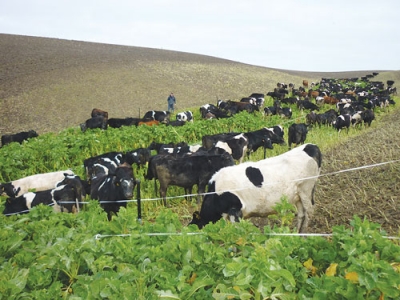 Trial suggests that winter grazing management can reduce nutrient losses to waterways.
Recent results from AgResearch trials in South Otago as part of the Pastoral 21 project have shown that grazed winter forage crops contribute significantly to the risk of nutrient losses to water.
However, with careful management, sediment and phosphorus losses can be reduced during grazing.
DairyNZ developer Maitland Manning says strategic grazing and careful management of wet areas such as gullies and swales in winter forage crops can reduce losses of sediment and phosphorus (P) to surface runoff by 80-90%.
“Gullies and swales are where overland flow and seepage converge to form small channels of running water, which may then flow to streams and rivers. By minimising stock movements and soil treading damage in these areas, any rainfall and runoff that occurs is more likely to infiltrate the soil, reducing the amount of runoff and loss of sediment and P,” says Maitland.
“Simple changes in grazing management of winter crops can result in huge benefits for farmers as well as the environment.”
Strategic grazing means letting cows graze the drier parts of the paddock first and the wetter parts last. This usually means the cows start at the top of the catchment and graze their way downhill towards the gully or swale. The uneaten crop acts as a buffer to minimise the runoff risk.
“If it needs to be grazed at all, the break nearest the gully or swale should be grazed at a time when the soil moisture content is not too high.
“Back fencing as much as possible will minimise soil pugging and compaction damage, and will also help to reduce volumes of surface runoff,” says Maitland.
Southland farmer Geoff Baldwin says he has noticed an improvement in sediment runoff since he has made changes to the way he winters his stock on swedes and kale at his Riverton property.
“Wintering can be a mission here with wet soil, so anything we can do to mitigate sediment losses is beneficial,” says Baldwin.
“We have identified and fenced off swales and we leave a 3-4m boundary along the fenceline which is kept in grass and not ploughed. Sediment is washed into the swales and settles in the grass, so sediment from the crop is reduced. We always graze the crop in front of the cows so the swale is the last place the cows get to,” says Baldwin.
Tips to reduce run-off
Beef + Lamb New Zealand is reminding farmers with lucerne stands to graze them hard over the next few weeks in preparation for a winter weed control programme.
Southland farmers are being encouraged to get ahead of the winter grazing season by attending a practical field day in Pukerau next week.
Tararua district farmer Jamie Harris milks around 400 cows using a split calving system on his farm, Crossdale Dairies.
Water management is an integral component of sustainable farming practices, according to Watermetrics.
Farmers wanting to establish subterranean clovers in their pastures this autumn are encouraged by Beef + Lamb NZ to graze pastures down to 700-1000 kg DM/ha prior to sowing.



Entries opened on Monday, 5 October 2026 for the 2027 New Zealand Dairy Industry Awards (NZDIA), which organisers describe as the nation's biggest celebration of excellence in the dairy sector.
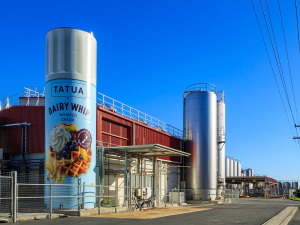
Waikato milk processor Tatua has again declared a record milk payout to farmer shareholders, leaving other processors in the dust.
A Labour-led Government won’t be bringing back the controversial freshwater rules of 2020.
National’s much-touted free trade deal with India featured in the Rural Issues Debate at Mystery Creek, Hamilton on Wednesday night.
New Zealand's 2026-27 freshwater fishing season has opened, with anglers encouraged to head to rivers and lakes over the coming days as conditions look favourable across much of the country.
Central Otago District Council (CODC) has voted against a plan to spread treated sewage sludge from Cromwell and Alexandra on farmland near Lauder, a decision Federated Farmers says reflects strong opposition from rural residents.
OPINION: It seems Canterbury processor Synlait is still in the doldrums.
OPINION: Get offside with New Zealand First leader Winston Peters at your own peril.




